10 Best Alsace Christmas Markets & Planning Guide (2026)
Discover the 10 best Alsace Christmas markets for 2026. Includes expert tips on the Navette de Noël shuttle, local food, and hidden village gems.
On this page
10 Best Alsace Christmas Markets & Planning Guide
The Alsace region transforms every November into one of Europe's most cinematic Christmas landscapes. Timber-framed houses strung with pine boughs, narrow cobblestone streets glowing amber at dusk, and the persistent scent of vin chaud and cinnamon make this corner of northeastern France unlike anywhere else in December. Planning a trip here, however, requires more than bookmarking pretty photos.
This guide covers all the major markets across the Haut-Rhin and Bas-Rhin departments — from the grand Christkindelsmärik in Strasbourg to the intimate circular lanes of Eguisheim. It also includes the practical details that most guides skip: the specific Navette de Noël shuttle lines, the per-village crowd and parking realities, and the distinction between Alsatian and German market traditions that shapes what you actually find in your cup. Dates and hours listed below are based on the 2025 season and subject to confirmation for 2026 — check the official christmas.alsace tourism board before booking travel around specific dates.
Many travelers wonder Is Colmar Worth Visiting? 10 Reasons to Visit & Travel Guide during the busy peak season. The answer is yes, as long as you know which days to arrive and which markets to pair together. Our guide starts with the two main bases and works outward to the wine-route villages.
Free guide: France's Hidden Gems
12 under-the-radar places across Provence, Alsace & Occitanie — with the best season to visit each and a local tip you won't find in the guidebooks.
Strasbourg: The Capital of Christmas
Strasbourg has claimed the title Capital of Christmas for good reason. The city hosts 13 separate markets spread across the Grande Île, welcoming over two million visitors each season. The centrepiece is the 30-metre Grand Sapin at Place Kléber, where a sound-and-light show runs every hour from 16:00 to 21:00 throughout the market season. The Christkindelsmärik at Place Broglie is the historic core of the event, tracing its origins to 1570 and offering 300 wooden chalets with a strong focus on Alsatian ornaments and traditional crafts.
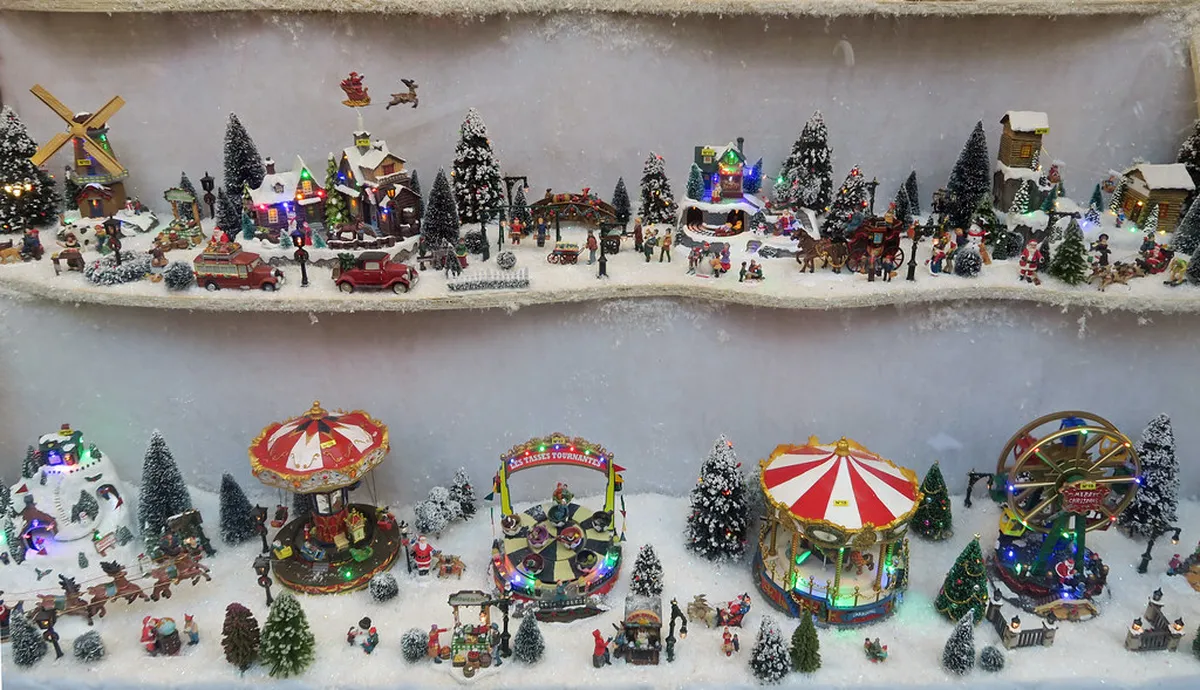
Markets fan out from Place Kléber to Place de la Cathédrale, Place du Château, Place Saint-Thomas, and along Rue Gutenberg. The entire area is closed to car traffic, so you can drift from square to square under overhead light garlands without worrying about traffic. The Grande Île neighbourhood of Petite France — where the canals narrow and the tanneries stack up — adds a second focal point well south of Place Kléber and is worth building in as a separate walk. Stalls at Strasbourg are open daily from 11:30 to 21:00 and the 2025 dates ran from 26 November to 24 December.
If you are arriving from Paris, the TGV from Gare de l'Est takes about 1 hour 40 minutes to Strasbourg, making it a viable overnight-only trip from the capital. A direct train from Strasbourg to Colmar takes under 30 minutes. Strasbourg is the better base for those who want a city atmosphere and maximum hotel choice; Colmar is better for those who prioritise access to the wine-route villages.
The Navette de Noël shuttle network operates from November through December on three fixed lines from Colmar train station. Purchase an all-day pass (approximately €10) for unlimited transfers—significantly cheaper than hourly parking across multiple villages. Weekday service runs every 60–90 minutes; weekend service every 30 minutes. Always download the schedule before leaving your hotel, as mobile signal in the Vosges valleys can be unreliable.
Colmar: A Fairytale Setting
Colmar concentrates six distinct market zones within a walkable old town that is arguably more photogenic than Strasbourg at street level. The most photographed is Petite Venise, where canal-side half-timbered houses reflect in the water under garlands of lights. The Place des Six Montagnes Noires market in Petite Venise leans toward wooden toys and a mechanical nativity scene, making it particularly good for families. The Place de la Cathédrale hosts the Marché Gourmand, a newer-format market focused on live food demonstrations and regional produce.
Our Colmar Christmas Market Guide: 10 Essential Tips & Locations covers the six zones in depth. The headline practical detail: the city centre closes to cars during the season. Free park-and-ride shuttles run from the train station, and paid garages near the markets include Parking Place Rapp and Parking de la Mairie Colmar. If you are not driving, the direct train from Paris Gare de l'Est to Colmar takes around 2 hours 30 minutes. The 2025 season ran from 25 November to 29 December.
Colmar is the best base for reaching the wine-route villages by shuttle. Staying here puts Eguisheim 15 minutes away by road and Riquewihr under 25 minutes. The compact scale also means you can cover all six market zones on foot in a half day, leaving full days free for village excursions.
Which Is Better: Colmar or Strasbourg?
Strasbourg wins on scale, variety, and city energy. It has 13 markets versus Colmar's six, and the sheer density of light installations across the Grande Île creates a spectacle that smaller towns cannot match. It is also the clear choice if you want to combine the market trip with a major European city break. The Grand Sapin at Place Kléber is genuinely one of the most impressive Christmas trees in Europe.
Colmar wins on intimacy and village access. The half-timbered streetscapes in Colmar's old town are denser and more intact than in central Strasbourg, and the proximity to the Navette de Noël shuttle network puts Eguisheim, Riquewihr, and Ribeauvillé all within easy day-trip range. You can read the detailed comparison in our Strasbourg or Colmar breakdown. For most first-time visitors, the practical answer is: base yourself in Colmar, take a day trip to Strasbourg, and use the other days for the wine-route villages.
Riquewihr: Medieval Charm
Riquewihr sits 23 km northwest of Colmar, nestled inside medieval ramparts with vineyards pressing right up to the walls. The village has a population of around 1,100 and the Christmas market fills its single main street — from the lower market near the entrance gate up to the medieval tower at the top. Unlike the other villages, Riquewihr is one of the few Alsatian Christmas markets where you can still find ceramic mugs rather than plastic eco-cups; stalls near the top of the main street sell hot chocolate and vin chaud in frosted glass or ceramic mugs with market-specific designs. For collectors used to German market mugs, this is worth knowing in advance.
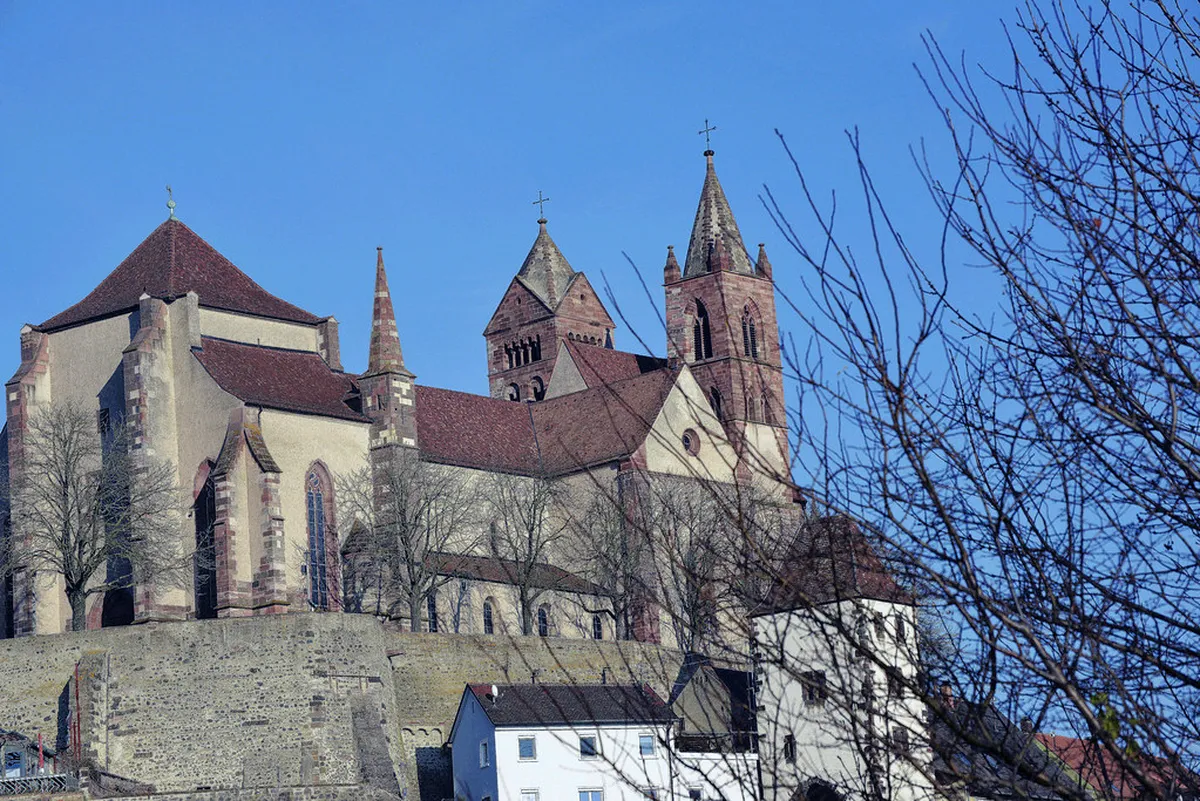
The stalls run daily from approximately 10:00 to 18:30, and the 2025 season ran from 29 November to 21 December — a shorter window than most other markets in the region, so plan accordingly. There is no parking inside the village walls. A small pay lot on the outskirts charges around €4.50 per hour, and spots disappear by mid-morning on weekends. The better option is the Navette de Noël from Colmar (Line 1), which deposits you at the village entrance and removes the parking problem entirely.
Eguisheim: Circular Village Magic
Eguisheim is frequently cited as one of the Most Beautiful Villages in France, and the Christmas market makes that designation feel earned. The village is built in concentric circles of coloured half-timbered houses around a central fountain, so the market follows an orbital route rather than a single main street. Around 30 stalls from local craftspeople fill the Place Saint-Léon at the centre, selling handmade pottery, Alsatian wine, and decorative items. An hour to 90 minutes covers the market comfortably; the surrounding streets deserve another hour if you want to appreciate the architecture.
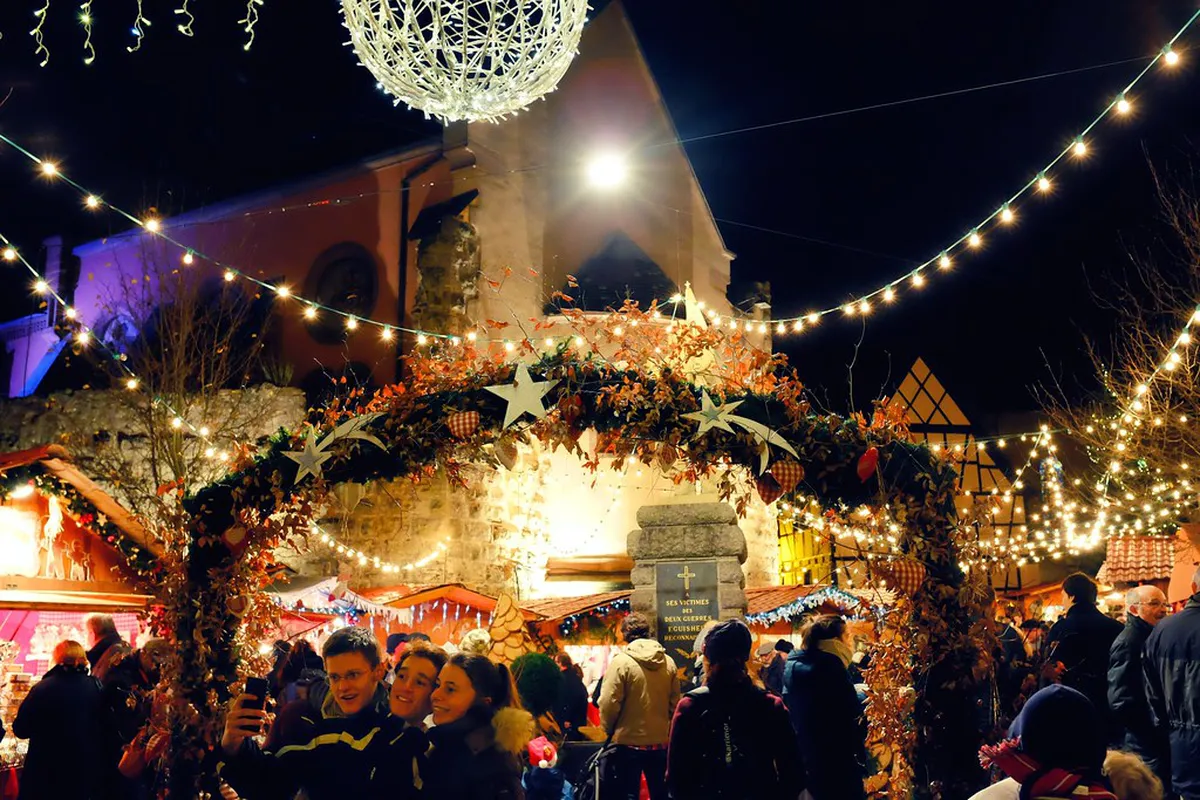
Eguisheim is a natural Eguisheim Travel Guide: 8 Best Things to Do & Planning Tips — the drive is 15 minutes and the Navette de Noël Line 2 covers it from the Colmar train station. If you drive, use Parking de la Mairie or Parking des Marronniers on the outskirts; both are €4 per day. The 2025 season ran from 28 November to 30 December, giving it one of the longer windows in the region. Visit on a Tuesday or Wednesday morning to find the stalls fully set up but the crowds a fraction of weekend levels.
Ribeauvillé: The Medieval Market
Ribeauvillé's Christmas market is the most theatrical in the region. The entire village adopts a medieval theme: stallholders dress in period costume, stilt walkers and fire eaters work the main street, live sheep and camels appear in a nativity tableau, and a whole wild boar turns on a spit over an open fire. Come nightfall, characters from local myths and legends take over the streets. The market extends well beyond the main street into side squares, making it more expansive than it first appears.
The critical logistical fact is that Ribeauvillé only opens on the first two weekends of December — in 2025 that was 6, 7, 8, 13, and 14 December. Plan around these specific dates or you will arrive to a closed village. Parking at Parking Klée offers two hours free; the larger Parking Jardin de Ville is free throughout. The Christmas shuttle Line 1 from Colmar also serves Ribeauvillé and is the easiest option if you do not want to deal with weekend parking in the surrounding hills.
Obernai: Gastronomy and Tradition
Obernai sits 20 km south of Strasbourg and is most easily reached from there — a 30-minute regional train costs under €10. The Christmas market fills the square in front of the Belfry with around 40 wooden chalets. The food focus here is sharper than in the larger cities: expect foie gras, spiced pain d'épices, and the village's own white mulled wine made with local Obernois wine and heated in a giant cauldron — a distinct regional variation on the standard vin chaud. The 2025 season ran from 28 November to 31 December, but market stalls close at 18:00, earlier than most other locations, so plan arrivals for mid-afternoon at the latest.
Obernai is the most practical add-on from Strasbourg rather than from Colmar. If you are spending a day in Strasbourg and want a smaller village comparison without driving, Obernai is the logical choice. Free parking is available at Parking Remparts, a short walk from the centre.
Kaysersberg: Authentic Artisan Spirit
Kaysersberg positions itself as the quality benchmark among the Alsatian village markets. Stalls are concentrated at Cour de l'Arsenal and behind the Sainte-Croix church, with a Christmas farmers' market on Place de la Mairie. The selection skews toward local honey, hand-carved wood objects, and seasonal produce rather than mass-produced decorations — a deliberate policy by the town to keep the market artisanal. Albert Schweitzer, the Nobel Prize-winning doctor and humanitarian, was born here, and a small permanent museum on the main street is open throughout the market season if you want context beyond the stalls.
The biggest limitation is operating hours: Kaysersberg markets only open Friday through Sunday during December, making it impossible to combine with a weekday itinerary. Parking is limited in town; Parking Guebwiller and Parking P1 Vieille Ville are the main options, or use the Navette de Noël Line 1 from Colmar. Allow two hours minimum to walk the fortified bridge, browse the stalls, and have a drink in the central square.
Essential Logistics: Navette de Noël Shuttle Guide
The Navette de Noël runs on three lines departing from the Colmar train station and the Saint-Eloi parking lot. Line 1 covers the northern wine-route cluster: Kaysersberg, Riquewihr, and Ribeauvillé in a circular route. Line 2 serves Eguisheim, the closest village to Colmar at roughly 15 minutes by road. Line 3 heads west into the Vosges foothills toward Turckheim and Munster. An all-day pass costs approximately €10 and allows unlimited transfers between lines — significantly cheaper than hourly parking across multiple villages.
On weekdays, buses on Line 1 run every 60 to 90 minutes, so missed connections mean a long wait. On weekends, frequency increases to roughly every 30 minutes. Download the schedule from the official tourism board before you leave your hotel; mobile signal in the Vosges valleys can be unreliable. A practical rule: do not plan more than two Line 1 villages in a single day if you are relying solely on the shuttle. The riding time between stops, combined with two to three hours per village, fills a day comfortably.
| Town | Dates (2025) | Highlight | Distance from Colmar |
|---|---|---|---|
| Strasbourg | 26 Nov – 24 Dec | 13 markets, 30m Grand Sapin, Christkindelsmärik (1570-origin) | 50 km (TGV 30 min) |
| Riquewihr | 29 Nov – 21 Dec | Medieval ramparts, ceramic mugs at stalls (uncommon in region) | 23 km (Navette Line 1) |
| Eguisheim | 28 Nov – 30 Dec | Circular village layout, Place Saint-Léon central market, longest season | 15 km (Navette Line 2) |
| Ribeauvillé | 6–8, 13–14 Dec | Medieval theme, costumed stallholders, theatrical nativity, first two weekends only | 24 km (Navette Line 1) |
| Kaysersberg | Open Fri–Sun in Dec | Artisan focus (local honey, hand-carved wood), fortified bridge walk | 23 km (Navette Line 1) |
| Obernai | 28 Nov – 31 Dec | Distinctive white mulled wine, 40 chalets, closes at 18:00 | 35 km from Colmar (via Strasbourg) |
If you are driving instead, note that Colmar and Strasbourg both close their historic centres to cars during the market season. Park at a peripheral garage and use the free city shuttles or walk in. For the smaller villages — Riquewihr in particular — parking is genuinely scarce by 10:00 on Saturdays. Arriving by 08:30 or using the shuttle are your two reliable options.
You should also check the Colmar Parking Guide: 8 Essential Tips for Stress-Free Parking if you plan to leave a car at one of the main shuttle hubs for the day.
Crowd and Parking Calendar: When to Visit Each Market
The crowd experience in Alsace varies enormously by day of week, and no competitor guide maps this out clearly. Colmar on a Saturday evening in December is a sardine experience — the narrow streets between market zones become almost impassable by 17:00. Tuesday and Wednesday mornings are the practical sweet spot: stalls are fully set up, the atmosphere is genuinely festive, and you can actually stop and look at what is for sale. If your schedule forces a weekend visit to Colmar, aim to arrive before 10:00 and leave before 15:00, before the tour-bus influx peaks.
Strasbourg is more spacious and absorbs weekend crowds better, but Place Kléber at 18:00 on a Saturday in December still reaches capacity. The trick here is to use the outer markets — Place Saint-Thomas and Square Louise Weiss — as entry points and work inward, rather than starting at Place Kléber and fighting the crowd bottleneck. The smaller village markets (Eguisheim, Kaysersberg) are calm on weekday afternoons but can feel overwhelmed on Sunday afternoons when visitors combine them into a single loop from Colmar or Strasbourg.
Riquewihr deserves special mention: the main street is only about 300 metres long, and on peak weekends it becomes congested enough that the market atmosphere is lost. Arriving before 09:30 or after 17:00 — when many day-trippers have already left — transforms the experience. The village lights up beautifully in the last hour before closing, and the crowds thin noticeably.
The 2025 Christmas market dates and hours listed above are based on confirmed historical schedules, but Alsatian market organizers typically announce the upcoming season's dates by August. Before booking accommodation or planning specific village itineraries, verify current dates at the official christmas.alsace tourism board website. Markets generally run from late November through December 24, with a few reopening December 26, but individual village hours vary significantly—Kaysersberg operates only Friday–Sunday, while Riquewihr closes earlier than other locations.
What to Eat and Drink: Alsatian Festive Flavors
Vin chaud at Alsatian markets comes in both red and white varieties. The white version, made from local Riesling or Pinot Blanc, is a specific regional specialty that differs from anything you will find at a German Christmas market. Prices run €3–5 plus a €1–2 eco-cup deposit. The eco-cup is a returnable plastic cup — not a collectible ceramic mug. This is the most important expectation to calibrate before you arrive: Alsatian markets do not follow the German glühwein mug tradition. Most stalls use a plastic cup with a seasonal design; Riquewihr is a partial exception where glass and ceramic cups appear at some vendors. Return the cup to any vendor for a refund when you are done.
For food, flammekueche (also called tarte flambée) is the defining market snack — an ultra-thin wood-fired flatbread with crème fraîche, lardons, and caramelised onion. Bredele are small spiced biscuits that come in dozens of shapes and are sold pre-packaged in €8–15 bags, making them one of the better edible souvenirs. Manala is a brioche baked in the shape of a little man and traditionally eaten on Saint Nicholas Day (6 December). Kougelhopf, a ring-shaped brioche-style cake dusted with icing sugar, appears in bakery windows throughout the region. For something more substantial, Knack d'Alsace (a smoked sausage served with choucroute) and Spätzle (egg noodles, often finished with cheese) are the closest the markets get to a full meal.
At Obernai, look specifically for the white mulled wine made with Obernois wine and heated in a cauldron — it is a sub-regional variant worth trying alongside the standard vin chaud. At Kaysersberg, the honey stalls are genuinely local: Vosges forest honey from the hills directly above the village. At Mulhouse, try the Baeckeoffe, a slow-braised casserole with potatoes, leeks, and three types of meat marinated in white wine.
What to Buy: Authentic Alsatian Souvenirs
The most common tourist mistake at these markets is buying generic glass baubles that could have been made anywhere. The authentic regional items are distinct. Meisenthal glass ornaments, produced at the historic Meisenthal glassworks in the Vosges near the German border, have been made using the same mouth-blown technique since the 1850s. The glassworks revived production specifically for Christmas after a period of closure, and the ornaments — typically €15–40 each — carry a certification of origin. They are fragile and expensive, but a Meisenthal bauble is a genuinely traceable souvenir rather than a warehouse import.
Soufflenheim pottery is another specifically Alsatian tradition. The distinctive terracotta pieces — bowls, tureens, and baking dishes glazed in ochre, green, and rust — date to the Bronze Age in the Bas-Rhin village of Soufflenheim. Look for it at the Strasbourg and Colmar markets, priced from around €15 for small pieces. Kelsch textiles — the red-and-white or blue-and-white Alsatian check fabric — appear on tablecloths and tea towels throughout the markets; this is the same pattern used ceremonially at Alsatian weddings and folk festivals. Mulhouse takes it furthest, debuting a new Christmas Kelsch design every year that becomes the visual identity for the entire market season.
For wine, buy directly from producers rather than from generic market stalls. Riquewihr and Eguisheim are both surrounded by Grand Cru vineyards, and several domaines set up stalls at the markets with bottles priced €8–20 for wines (Riesling, Gewurztraminer, Pinot Gris) that would cost twice as much in a Paris wine shop.
Where to Stay: Choosing Your Base
Colmar is the most practical base for anyone who wants to cover multiple wine-route villages. It sits centrally between Eguisheim (15 min), Riquewihr (25 min), and Ribeauvillé (20 min), and the Navette de Noël departs from the train station. The trade-off is that Colmar hotels fill up fast and prices spike significantly in December — book at least two months in advance. Staying near Place Rapp or the Unterlinden Museum puts you within five minutes' walk of the main market zones. Check our where to stay in Colmar guide for vetted neighbourhood-by-neighbourhood options.
Strasbourg is the better base if you want the widest hotel choice, lower prices relative to Colmar, and the option to spend a full day in the city markets without commuting. The Grande Île and the area around Place Kléber are the obvious neighbourhoods for market proximity. Strasbourg is also the natural base if your trip begins with a flight into Paris and a TGV connection — the 1h40 train avoids the Colmar transfer.
A third option that both competitor pages highlight is staying in a mid-point village outside the main cities — somewhere like Breitenbach in the Vosges foothills. This approach avoids the December hotel price surge in Colmar and Strasbourg and gives you a quieter base, but adds 30–40 minutes of driving to every market visit and is only viable if you have a car. For three to four nights, the flexibility of a car rental outweighs the inconvenience of the longer commute into each town.
Frequently Asked Questions
What is the best town to base yourself in for Alsace Christmas markets?
Colmar is the ideal base because it sits centrally between the most famous wine-route villages. It offers a fairytale atmosphere and easy access to the Navette de Noël shuttle system. Staying here allows you to reach Eguisheim and Riquewihr in under twenty minutes.
How do I use the Alsace Christmas shuttle (Navette de Noël)?
Purchase an all-day ticket at the Colmar train station or online for approximately $10. Buses run on three main lines connecting Colmar to surrounding villages like Kaysersberg and Ribeauvillé. Check the schedule carefully as weekday service is less frequent than weekend service.
Are the Alsace Christmas markets open on Christmas Day?
Most markets in the region close by the afternoon of December 24th and remain closed on Christmas Day. A few larger markets in Colmar or Strasbourg may reopen on December 26th. Always verify specific town dates before booking your travel for the holiday week.
Visiting the Alsace Christmas markets is a bucket-list experience that rewards careful planning. Base yourself in Colmar, use the Navette de Noël to reach the wine-route villages, and target weekday mornings for the most authentic atmosphere. Invest in one Meisenthal glass bauble or a bottle of Grand Cru Riesling bought directly from a producer — those are the souvenirs that make the trip memorable years later.
Whether you are drawn to the grand spectacle of Strasbourg's Grand Sapin or the intimate orbit of Eguisheim's circular market, plan to spend at least three to four days in the region. The markets of Alsace cover a December window from late November to Christmas Eve — start planning your 2026 trip early to secure accommodation in Colmar before prices climb.
Free guide: France's Hidden Gems
12 under-the-radar places across Provence, Alsace & Occitanie — with the best season to visit each and a local tip you won't find in the guidebooks.
You might also like


Continue reading
More guides you'll find useful