Le Panier, Marseille: The Old Town Quarter Guide (2026)
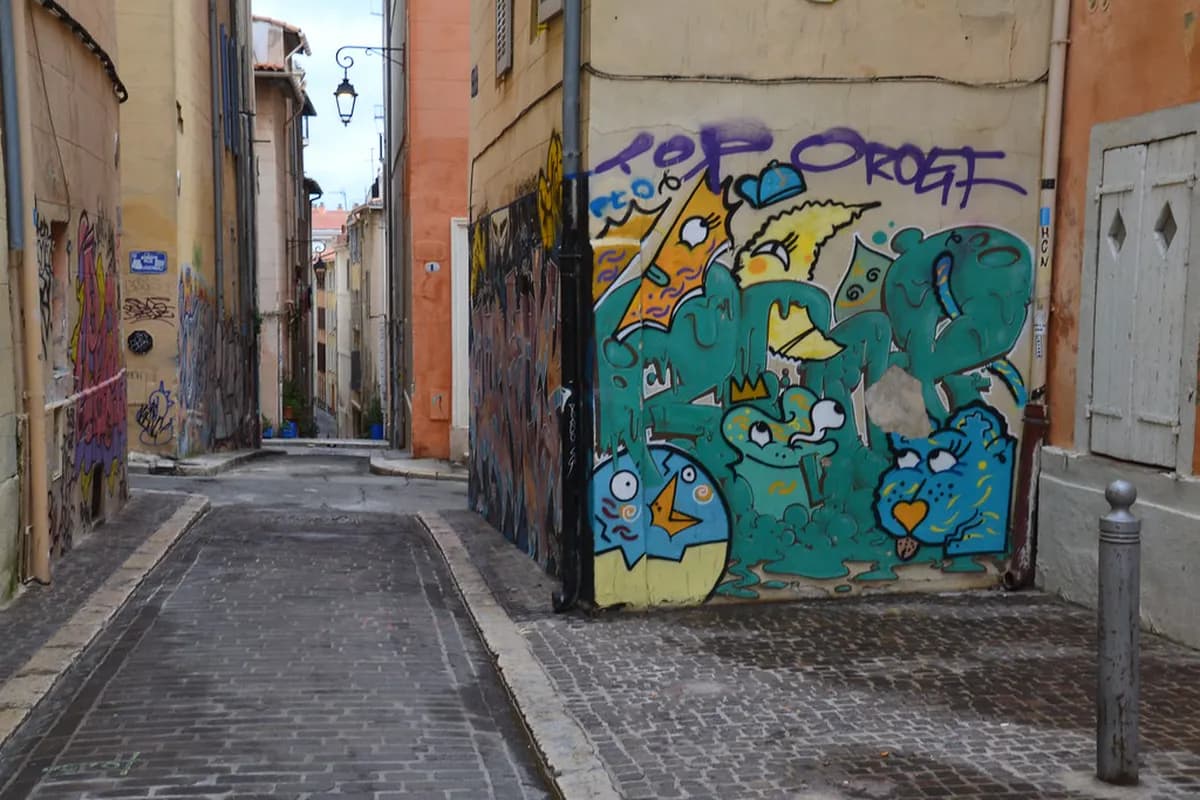
Le Panier is the oldest quarter of Marseille — and, arguably, the oldest neighbourhood in all of France. This is where Greek sailors from Phocaea founded the colony of Massalia around 600 BC, on the rising ground just north of the Vieux-Port. Today Le Panier is a hilly, sun-bleached maze of narrow streets and staircases climbing over three small hills, its ochre and pastel walls draped with linen and splashed with constantly changing street art. It is a place of tiny village squares, artisan workshops, soap-makers and ceramicists, neighbourhood cafés, and the great baroque courtyard of the Vieille Charité. Best of all, the quarter itself is completely free to wander — there is no ticket and no closing time, just lanes to get pleasantly lost in. This 2026 guide covers what to see, how to explore the streets, how to get there, and what lies nearby.
What to See (Vieille Charité, Squares, Street Art)
The headline monument is La Vieille Charité, a serene baroque ensemble built between 1671 and 1749 to designs by the Marseille-born sculptor and architect Pierre Puget (1620–1694), who rose to become an architect to Louis XIV. Four ranges of three-storey arcaded galleries surround a central courtyard dominated by a chapel with an egg-shaped dome — one of the most beautiful interior spaces in the city. Originally an almshouse, it was restored between 1970 and 1986 and now houses two museums: the Museum of Mediterranean Archaeology on the first floor and the Museum of African, Oceanic and Amerindian Art on the second, along with a bookshop and café. Wandering the arcaded courtyard is free; the museums charge a modest admission, and temporary exhibitions are often the highlight.
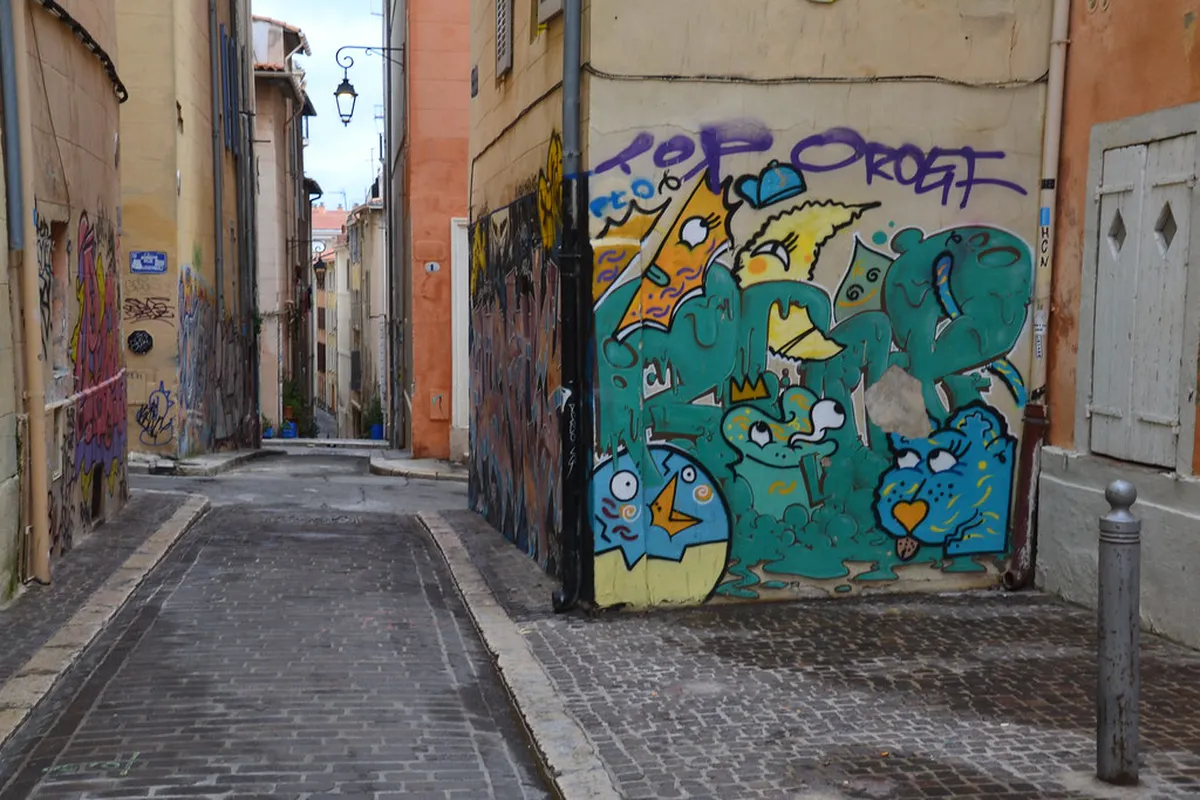
The quarter is also a collection of intimate squares. Place de Lenche, near the top of the hill, sits on the site of the ancient Greek agora and Roman forum and is now a leafy café terrace with glimpses down to the harbour. Place des Moulins, the highest point, takes its name from the fifteen windmills that once crowned the hill in the 16th century — three stone mill-bases survive, and the square today feels like a quiet village green. Throughout the lanes you will find street art in every register, from large painted frescoes to playful stencils and mosaics, refreshed so often that no two visits look quite the same.
Wandering the Streets
Le Panier is best treated not as a checklist but as a place to drift. The lanes are too narrow and too steep for through-traffic, so this is one of the few corners of Marseille made entirely for walking. From the Vieux-Port, climb up behind the Hôtel de Ville and let yourself follow whichever staircase looks most inviting — almost every turn opens onto a painted wall, a hidden courtyard, or a workshop door left ajar.
The quarter has reinvented itself as a hub of small, independent makers: soap-makers turning out the famous savon de Marseille, ceramicists, candle-makers, santon (clay-figurine) ateliers, and a scatter of design boutiques. Pause at the Bar des 13 Coins, a beloved corner café whose picturesque facade inspired Roland's bar in the long-running French TV soap Plus Belle la Vie — the series was set in a fictional Marseille neighbourhood directly inspired by Le Panier, and many of its exterior scenes were shot in these very streets. The quarter is steep and the cobbles are uneven, so wear comfortable shoes; the reward is the most atmospheric, village-like square kilometre in the whole city. The streets are public, free, and open at all hours, though daytime is when the shops, cafés, and the Vieille Charité are open.
Getting There
Le Panier occupies the rising ground in Marseille's 2nd arrondissement, immediately north of the Vieux-Port and behind the Town Hall. The easiest approach is by métro: take Line 1 to Vieux-Port station and walk five minutes up the hill past the Hôtel de Ville, or take Line 2 to Colbert (or Joliette) and drop down into the quarter from the north. From either station the climb is short but genuinely uphill, with steps along the way.
On foot, the whole quarter is a 10–15 minute stroll from the Vieux-Port waterfront and just a few minutes from Fort Saint-Jean and the MuCEM on the harbour mouth. Driving is not recommended — the lanes are barely wide enough for a delivery scooter — so leave any car in a Vieux-Port or Joliette car park and arrive by métro or on foot. For where Le Panier fits into a full visit, see our things to do in Marseille guide and our Le Panier and Old Port neighbourhood guide.
Nearby
Le Panier sits right at the heart of historic Marseille, so the rest of the old city is within a few minutes' walk. Down the hill is the Vieux-Port, the city's ancient harbour, ringed with cafés and the morning fish market and crowned by Norman Foster's mirrored sun-shade pavilion. At the harbour mouth you reach Fort Saint-Jean, linked by footbridge to the striking lattice-clad MuCEM (Museum of European and Mediterranean Civilisations) and its rooftop views.
A short way uphill from the port stands the great Romanesque-Byzantine cathedral, La Major, while the panoramic basilica of Notre-Dame de la Garde — Marseille's most famous landmark — crowns the hill on the south side of the port, an easy onward trip. Combine Le Panier with the Vieux-Port and MuCEM for a half-day exploring the oldest and most photogenic part of the city.
Frequently Asked Questions
Is Le Panier free to visit?
Yes. Le Panier is a public neighbourhood of Marseille's old town, so wandering its streets, staircases, and squares is completely free, with no ticket and no opening hours. You only pay if you choose to enter the museums inside the Vieille Charité or buy something from the artisan shops and cafés.
What is the Vieille Charité and is it worth seeing?
The Vieille Charité is a baroque former almshouse built between 1671 and 1749 by Pierre Puget, with three storeys of arcaded galleries around a domed central chapel. It now houses the Museum of Mediterranean Archaeology and the Museum of African, Oceanic and Amerindian Art. The courtyard is free to walk through; the museums charge a small admission and are well worth it.
How do I get to Le Panier from the Vieux-Port?
Le Panier is a five-minute walk uphill from the Vieux-Port métro station (Line 1), behind the Town Hall. You can also reach it from Colbert or Joliette station (Line 2) on the north side. The quarter is pedestrian-only and steep, so come on foot or by métro rather than by car.
Explore More of Marseille
- Things to Do in Marseille — the full city guide.
- Le Panier & Old Port Neighbourhood Guide — how to explore the old town on foot.
- Vieux-Port — the ancient harbour at the foot of Le Panier.