Palais Longchamp, Marseille: Palace, Fountain & Museums (2026)
The Palais Longchamp is Marseille's grandest monument that isn't a church — a sweeping 19th-century palace built not for a king but for water. Completed in 1869 to celebrate the arrival of the Canal de Marseille, which finally brought fresh water from the River Durance to a city that had endured cholera and drought, it takes the humble form of a water tower (château d'eau) and turns it into pure theatre: a colonnade curving in two great arms around a monumental fountain, crowned with sculpted bulls, lions, and allegories of the Durance. Behind the stonework sit two of the city's best museums and a free public park. This guide covers the 2026 essentials — the monument and fountain, the two museums (and the fact that their permanent collections are free), the gardens, and how to get there by métro.
The Monument & Fountain
The Palais Longchamp was designed by Henry Espérandieu, the architect who also gave Marseille the basilica of Notre-Dame de la Garde. His plans were approved in 1862, and the palace opened to the public on 15 August 1869. The brief was unusual: the city asked Espérandieu to dress up a functional water tower at the end of the new Canal de Marseille, and he answered with one of the most exuberant pieces of Second Empire architecture in southern France.
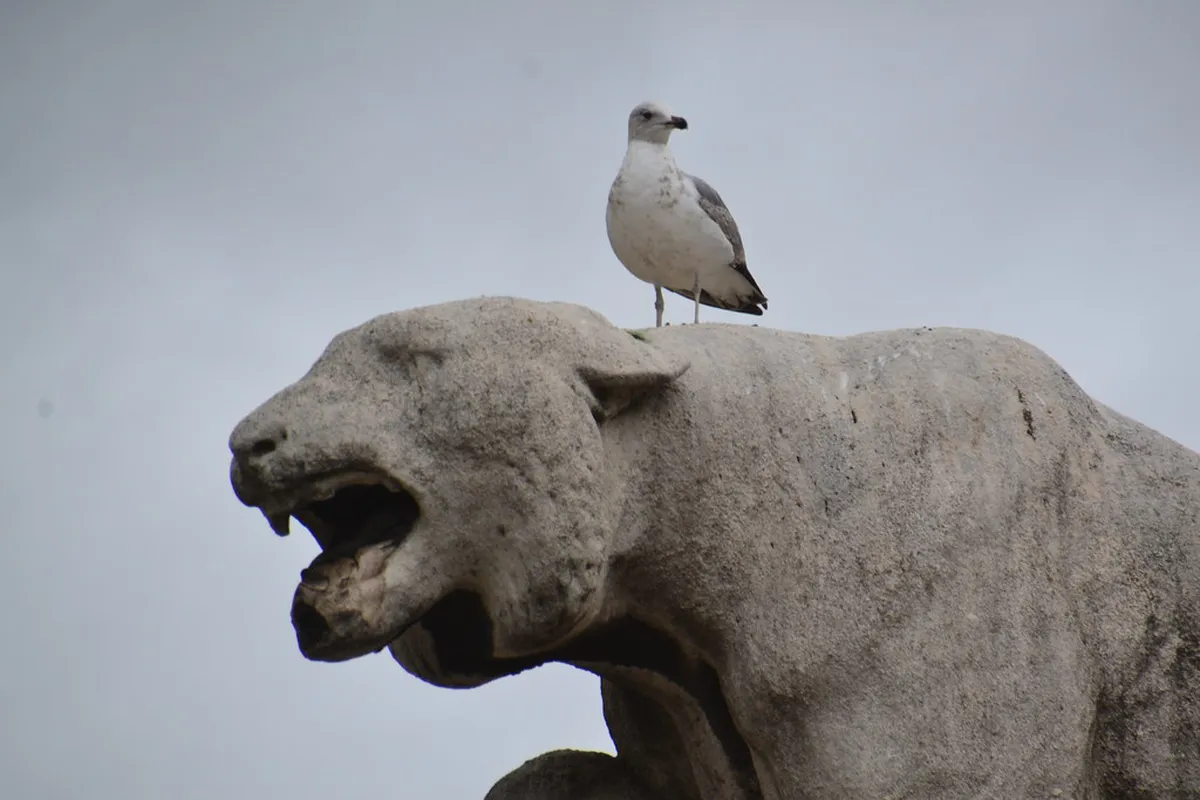
The composition is symmetrical and stagey. At the centre rises the château d'eau — the water tower — framed by a triumphal arch and spilling into a cascade and basin below. The fountain is alive with sculpture: a central group representing the Durance river as a woman riding a chariot drawn by Camargue bulls, flanked by figures of the vine and the wheat the water made possible. From this centrepiece two long curved colonnades sweep outward like open arms, each ending in a museum pavilion. Stand on the Boulevard Longchamp side at the bottom of the slope and the whole monument reads as a single grand backdrop — it is one of the most photographed views in Marseille, and entirely free to admire from the public space.
The Two Museums
The two colonnade wings each house a museum, and visiting them is one of the best-value cultural outings in the city.
In the left wing sits the Muséum d'histoire naturelle (Natural History Museum), one of the oldest in France, with rich collections of zoology, palaeontology, and a long-loved gallery of comparative anatomy and fossils. In the right wing is the Musée des Beaux-Arts (Fine Arts Museum), Marseille's oldest museum, holding French, Italian, and Provençal paintings and sculpture from the 16th to the 19th centuries, including works by local masters such as Pierre Puget.
Admission & hours (2026): Both museums are run by the Ville de Marseille, and entry to their permanent collections is free for all visitors — you only pay for temporary exhibitions (typically around €5 full / €3 reduced). Both are open Tuesday to Sunday, 9:00–18:00, and closed on Mondays (with annual closures on 1 January, 1 May, 1 and 11 November, and 25 December). Note that the surrounding park, and therefore museum access, can close during severe wind episodes, so check the official site before a windy-day visit.
The Gardens (free)
Behind the palace, the Parc Longchamp is a free public park open to everyone — a leafy, gently terraced green space that locals use for picnics, jogging, and escaping the summer heat. It is laid out in a relaxed English style, with lawns, mature trees, ornamental ponds, and grand stone staircases descending from the rear of the monument.
The park has its own history: it was once home to Marseille's zoo, and a few of the old animal enclosures and decorative structures survive as romantic, ivy-softened follies. There is plenty of room for children to run, shaded benches for a midday pause, and elevated terraces that give you a different, quieter angle on the back of the palace. Because admission to the park is free and it sits right beside the two free museums, the Palais Longchamp is one of the strongest budget-friendly half-days in the whole city — see our guide to free things to do in Marseille for more ideas in the same spirit.
Getting There
The Palais Longchamp is in the 4th arrondissement, a short hop northeast of the Vieux-Port. The easiest way to reach it is the métro: take Métro Line 1 to the Cinq Avenues – Longchamp station, which sits almost directly beside the monument — you exit and the colonnade is right there. From the Vieux-Port it is two or three stops, or roughly a 25-minute walk uphill via the Boulevard Longchamp, which lines you up with the classic fountain view as you approach.
Several bus lines and the tram network also pass nearby, and there is a tram stop close to the park entrance. Driving is not recommended — central Marseille parking is scarce and expensive — so the métro is by far the best option. If you are stitching together a day of sights, the palace pairs naturally with the city's other museums; see our Marseille museums and MuCEM guide for a full cultural itinerary, and the things to do in Marseille pillar for the bigger picture.
Frequently Asked Questions
Is the Palais Longchamp free to visit?
Mostly, yes. The monument, fountain, and the Parc Longchamp behind it are free public spaces, and the permanent collections of both museums inside — the Fine Arts Museum and the Natural History Museum — are also free for all visitors in 2026. You only pay for temporary exhibitions, typically around €5.
What are the opening hours of the museums at Palais Longchamp?
Both the Musée des Beaux-Arts and the Muséum d'histoire naturelle are open Tuesday to Sunday from 9:00 to 18:00 and are closed on Mondays, plus a handful of public holidays. The surrounding park can close during severe wind, which also blocks museum access, so check the official site on a windy day.
Which métro stop is closest to the Palais Longchamp?
Take Métro Line 1 to Cinq Avenues – Longchamp, which sits right beside the monument. From the Vieux-Port it is only two or three stops, making the métro the simplest way to get there.
Explore More of Marseille
- Things to Do in Marseille — the full city guide.
- Marseille Museums & MuCEM Guide — where the Longchamp museums fit in.
- Free Things to Do in Marseille — more budget-friendly sights.
- MuCEM — the waterfront museum of Mediterranean civilisations.