Place de la Comédie, Montpellier: Square Guide (2026)
Discover Place de la Comédie in Montpellier: the egg-shaped main square with the Three Graces fountain, Opéra Comédie, and vibrant café terraces.
On this page
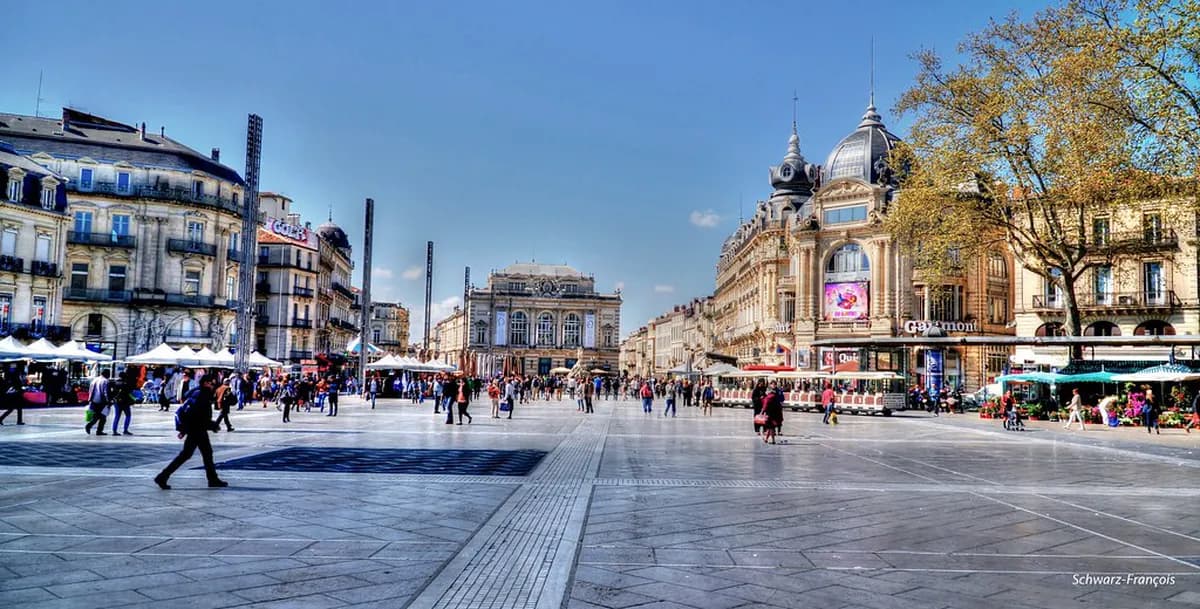
Place de la Comédie is the beating heart of Montpellier, a vast pedestrian plaza locals nickname l'Œuf ("the Egg") for its rounded, egg-shaped form. At its centre stands the famous Three Graces fountain, framed by the grand 19th-century Opéra Comédie and a long arc of café terraces. Free and open around the clock, it is the natural starting point for exploring the city — the gateway into the medieval Écusson old town and one of the first stops on any list of things to do in Montpellier. This 2026 guide covers what you will see, how to get there, when to visit, and what is nearby.
What You'll See
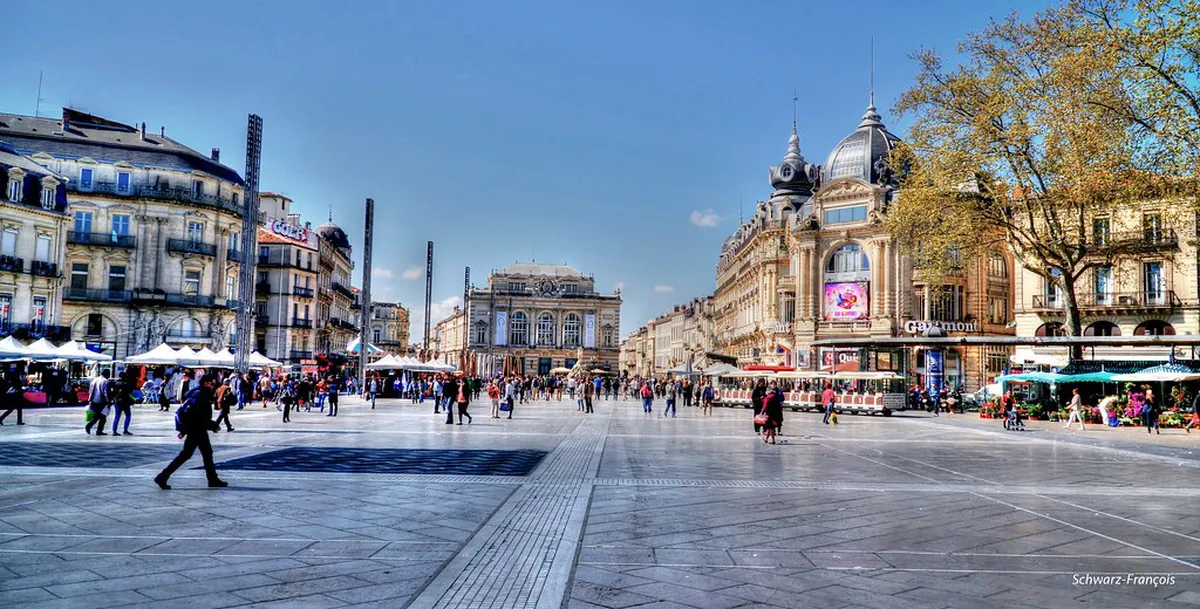
The square unfolds across roughly 18,500 square metres of pale, polished stone, making it one of the largest pedestrianised plazas in Europe. Its centrepiece is the Fountain of the Three Graces (Fontaine des Trois Grâces), whose figures represent the mythological sisters Aglaé, Euphrosyne and Thalie. The fountain dates to 1790; the sculpture now on display is a 1989 replica, with the original preserved inside the opera house.
Anchoring the southern end is the Opéra Comédie, an Italian-style theatre completed in 1888, its ornate façade and entrance staircase forming the postcard backdrop most visitors photograph. Ringing the plaza are Haussmann-era buildings whose ground floors host an unbroken line of brasserie and café terraces — the prime spot for people-watching, street performers and the slow rhythm of Montpellier life. To the north, the square opens onto the tree-lined Esplanade Charles-de-Gaulle leading to the Corum conference centre.
Getting There
Place de la Comédie sits at the dead centre of Montpellier and is exceptionally easy to reach. The Comédie tram stop is served by the city's tramway network — tram lines 1, 2, 3 and 4 all converge here, putting the square within a short ride of the main railway station, the airport shuttle and most neighbourhoods. From Gare Montpellier Saint-Roch it is barely a five-minute walk north along Rue Maguelone.
Because the entire plaza and the Écusson behind it are pedestrian zones, there is no point driving in; use one of the perimeter car parks (Comédie, Polygone or Antigone) and continue on foot or by tram. The square itself is flat, paved and step-free, with widened, accessible tram platforms suitable for visitors with reduced mobility.
Best Time to Visit
The square is open 24 hours a day and free to enter, so timing is purely about atmosphere. Early morning is calm and ideal for photographing the fountain and opera façade without crowds. Late afternoon into the golden hour is the most photogenic, when warm light catches the pale stone and the terraces fill up for the apéritif. Evenings are lively year-round, especially in summer when street musicians and performers gather.
Spring (April–June) and early autumn (September–October) offer the most comfortable temperatures; midsummer middays can be hot and shadeless across the open plaza, so claim a shaded terrace. The square is also the focal point for major events such as the Christmas market and Bastille Day celebrations. For a fuller walking route through the surrounding lanes, pair this stop with our Old Town & Place de la Comédie guide.
Nearby
From the square you can walk almost everywhere worth seeing. Step directly into the Écusson, the medieval old town, a maze of narrow streets, mansions and small squares immediately to the west. A few minutes north sits the Musée Fabre, one of France's leading fine-arts museums. Continue along the Esplanade to reach the Corum, while a longer stroll west through the old town brings you to the grand Place Royale du Peyrou and the Saint-Pierre Cathedral. The Polygone and Odysseum shopping districts extend eastward via tram.
Frequently Asked Questions
Is Place de la Comédie free to visit?
Yes. Place de la Comédie is a public square that is completely free to enter and open 24 hours a day, every day of the year. There is no ticket or admission fee.
Why is it called the "Egg"?
Locals nickname it l'Œuf ("the Egg") because of the rounded, oval shape the plaza took before its renovations — the egg outline is still echoed in the paving.
How do I get to Place de la Comédie by tram?
Take the tramway to the Comédie stop, which is served by lines 1, 2, 3 and 4. It is a short ride from Gare Saint-Roch and most parts of the city, or a five-minute walk from the main train station.