Aqueduc Saint-Clément (Les Arceaux), Montpellier: Guide (2026)
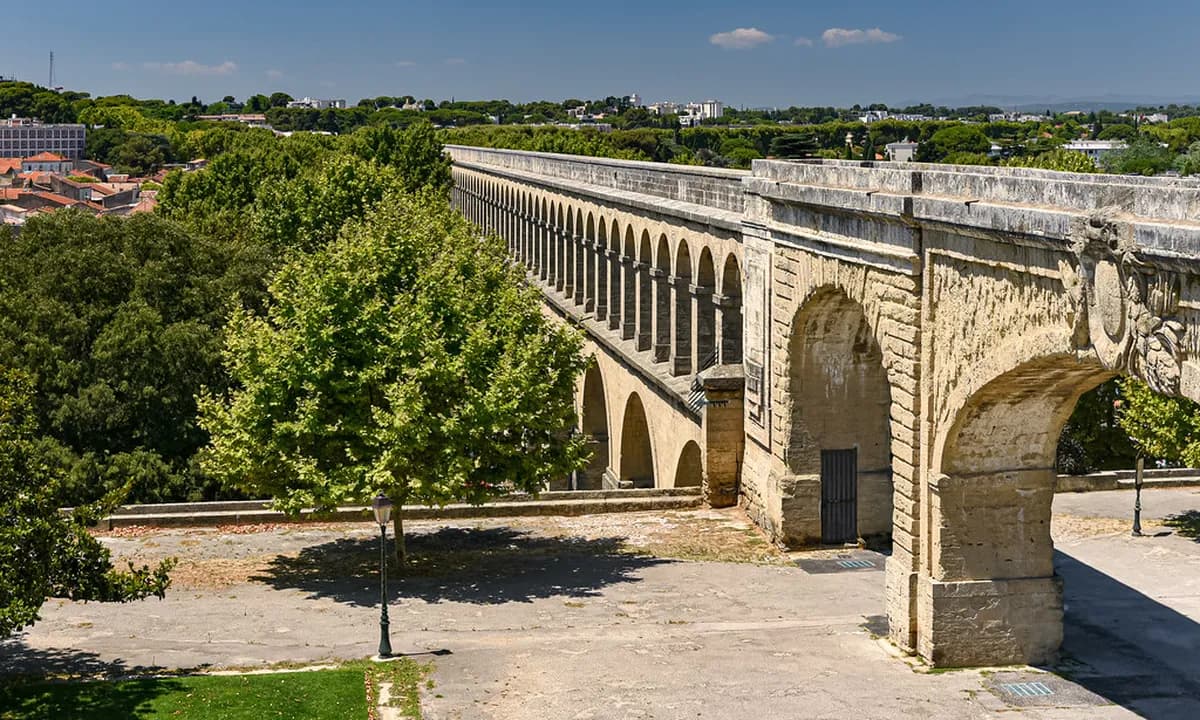
Stretching across the western edge of Montpellier's old town, the Aqueduc Saint-Clément, universally known as Les Arceaux, is the city's most photogenic piece of engineering. Its double tier of golden-stone arches once carried fresh spring water all the way to the Promenade du Peyrou, and today the long colonnade frames one of the liveliest market scenes in Occitanie. This 2026 guide covers what to expect: the aqueduct is free and open-air at all times, the famous Marché des Arceaux runs beneath the arches on Tuesday and Saturday mornings, and the best photographs are taken at the foot of the Peyrou where the structure soars to nearly 30 metres. Below you will find the history, the market, the top viewpoints, and how to get there.
History & Architecture
By the early 18th century Montpellier had outgrown its medieval wells, and the city needed a reliable way to bring water in from the Saint-Clément spring near Saint-Clément-de-Rivière, some 14 kilometres to the north. In 1751 the city council entrusted the project to Henri Pitot (1695–1771), the celebrated hydraulic engineer best remembered for inventing the Pitot tube. The first stone was laid on 13 June 1753, and after roughly twelve years of work the aqueduct was inaugurated on 7 December 1765, feeding the water tower (château d'eau) at the head of the Promenade du Peyrou and, from there, the public fountains of the city centre.
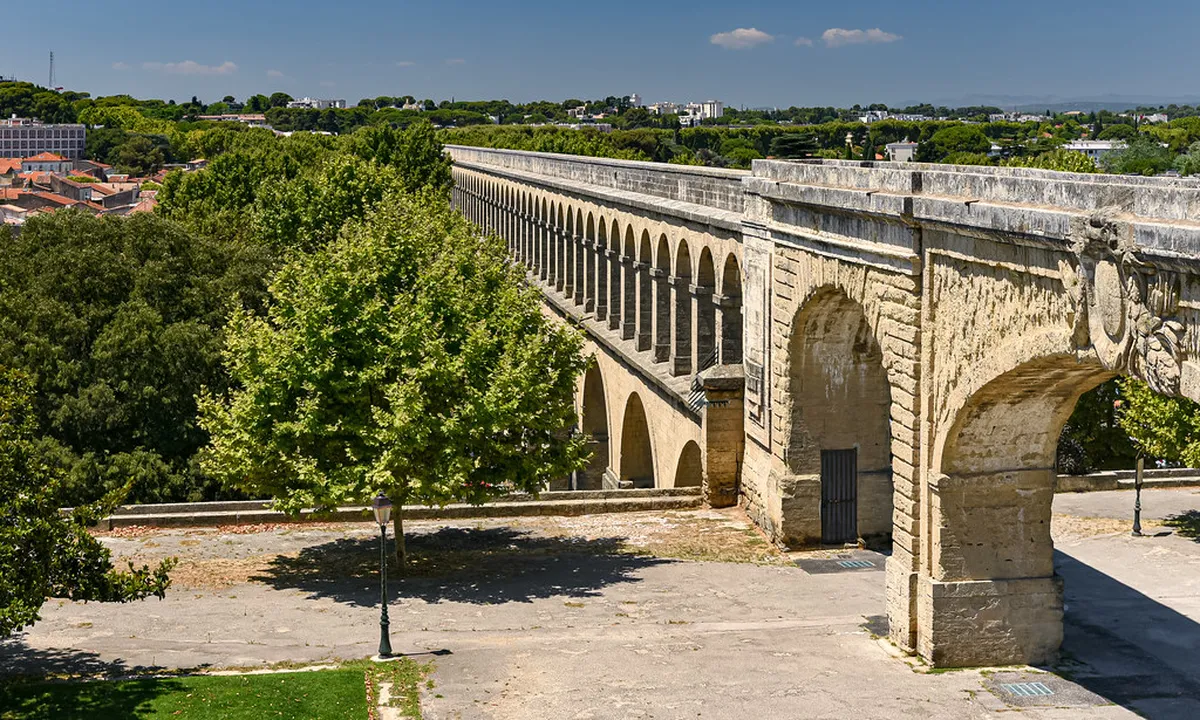
Pitot took clear inspiration from the Roman Pont du Gard. Where the line crosses the low ground at the edge of the old town, it rises on a spectacular double row of arcades that runs for about 800 metres and reaches close to 30 metres in height: a lower row of large arches carries an upper row of smaller arches, the slimmer top tier designed to resist cracking and water infiltration. It is this colonnade of "little arches" that gave the neighbourhood, and the monument, its everyday name, Les Arceaux. The aqueduct stopped carrying water in the early 1980s, but the structure survives intact; sections were protected as monuments historiques in 1954 and 1994, and the whole aqueduct was listed in 2022.
The Les Arceaux Market (Tue & Sat)
The single best reason to time your visit is the Marché des Arceaux, which sets up right beneath the arches on Tuesday and Saturday mornings, typically from around 7:00 until about 13:30. It is one of Montpellier's largest and most beloved markets, drawing up to 80 stallholders on a busy day, with a strong showing of local and organic producers: market gardeners, cheesemakers, bakers, olive-oil and honey sellers, herbs, and seasonal fruit and vegetables from the Hérault countryside, alongside a row of secondhand booksellers and craft stands.
Saturday is the bigger, busier day and has a festive, neighbourhood feel; Tuesday is calmer and easier for an unhurried browse. Arrive before 11:00 for the best produce and a clear shot of the arches, and bring cash and a tote bag. The market is the ideal pairing with a morning walk up to the Peyrou and makes the aqueduct feel like a living part of the city rather than a museum piece. For more on the city's food markets, see our guide to Montpellier markets, Les Halles and the flower market.
Best Views & Photo Spots
The classic composition is taken from the Boulevard des Arceaux, looking along the receding line of arches as it marches toward the Peyrou; the perspective of repeating columns is the shot that lands on most postcards. For the most dramatic angle, walk to the western end of the Promenade du Peyrou by the château d'eau, where the aqueduct is at its tallest and you can frame it against the formal terrace and, on clear days, the distant Pic Saint-Loup.
Light is best in the late afternoon and at golden hour, when the limestone glows warm against the sky; the structure also looks superb floodlit after dark. On market mornings, slip a few arches back from the busiest stalls to catch the arcade with the bustle below for a real sense of scale. Photographers chasing symmetry should aim for a low, head-on angle directly beneath an arch.
Getting There
The aqueduct sits just west of Montpellier's historic centre, immediately below and behind the Promenade du Peyrou. On foot it is an easy 10–15 minute walk from the Place de la Comédie: head up through the old town to the Peyrou, then descend toward the Boulevard des Arceaux. By tram, take line 4 to the Peyrou–Arc de Triomphe stop, which leaves you a two-minute walk from the top of the arches; tram lines 1 and 4 also serve the nearby Comédie stop. The area around the arches is largely pedestrian-friendly, so if you drive, use a central car park such as Parking Peyrou or Parking Arc de Triomphe and continue on foot. Access to the aqueduct and the open ground beneath it is free at all hours.
Nearby
The aqueduct is one half of a perfect pairing with the Promenade du Peyrou, the grand 17th–18th-century terrace it feeds, crowned by an equestrian statue of Louis XIV, the Arc de Triomphe, and the elegant château d'eau. For the full story of how the two monuments work together, read our guide to the Promenade du Peyrou and Saint-Clément aqueduct, or visit the dedicated entity page for the Promenade du Peyrou. From the Peyrou it is a short walk back into the old town for the cathedral, the museums, and the cafés of the Écusson. For more ideas on filling out your itinerary, browse the wider things to do in Montpellier.
Frequently Asked Questions
Is the Aqueduc Saint-Clément free to visit?
Yes. The aqueduct is an open-air monument and the ground beneath and around the arches is free to access at any time of day. There is no ticket and no opening hours; you simply walk up to it from the Promenade du Peyrou or along the Boulevard des Arceaux.
What days is the Les Arceaux market held?
The Marché des Arceaux is held under the arches on Tuesday and Saturday mornings, generally from around 7:00 to 13:30. Saturday is the larger and busier of the two days, with up to 80 stalls of local and organic producers; Tuesday is quieter.
Who built the aqueduct and when?
It was built between 1753 and 1765 under the engineer Henri Pitot to carry water from the Saint-Clément spring to the Promenade du Peyrou, drawing inspiration from the Roman Pont du Gard. It no longer carries water but survives as a listed historic monument.