
Promenade Du Peyrou Montpellier Travel Guide
Plan promenade du peyrou montpellier with top picks, neighborhood context, timing tips, and practical booking advice for a smoother trip.
On this page
Promenade Du Peyrou Montpellier
The Promenade du Peyrou is Montpellier's grandest public space — a 3-hectare royal esplanade built in the late 17th century at the city's highest point. From here you look south toward the Mediterranean and north toward the Cévennes, a panorama that no other spot in the city center can match. The ensemble of triumphal arch, equestrian statue, water tower, and aqueduct was designed as a single composition, and it reads that way even today.
Understanding what Montpellier is famous for almost always starts here. The promenade is free to enter at all hours, which makes it one of the most visited sites in the south of France without costing anything. Locals use it daily — for pétanque, jogging, Sunday markets, and evening strolls — so you are never just visiting a monument; you are stepping into the city's living room.
In 2026 the site is in excellent condition following recent conservation work on the stone balustrades. This guide covers everything you need to plan a visit: the landmarks in order, the Saint-Clément Aqueduct, the Sunday antique market with its full 2026 calendar, practical transport, and nearby highlights worth your afternoon.
Free guide: France's Hidden Gems
12 under-the-radar places across Provence, Alsace & Occitanie — with the best season to visit each and a local tip you won't find in the guidebooks.
Must-See Landmarks on the Promenade
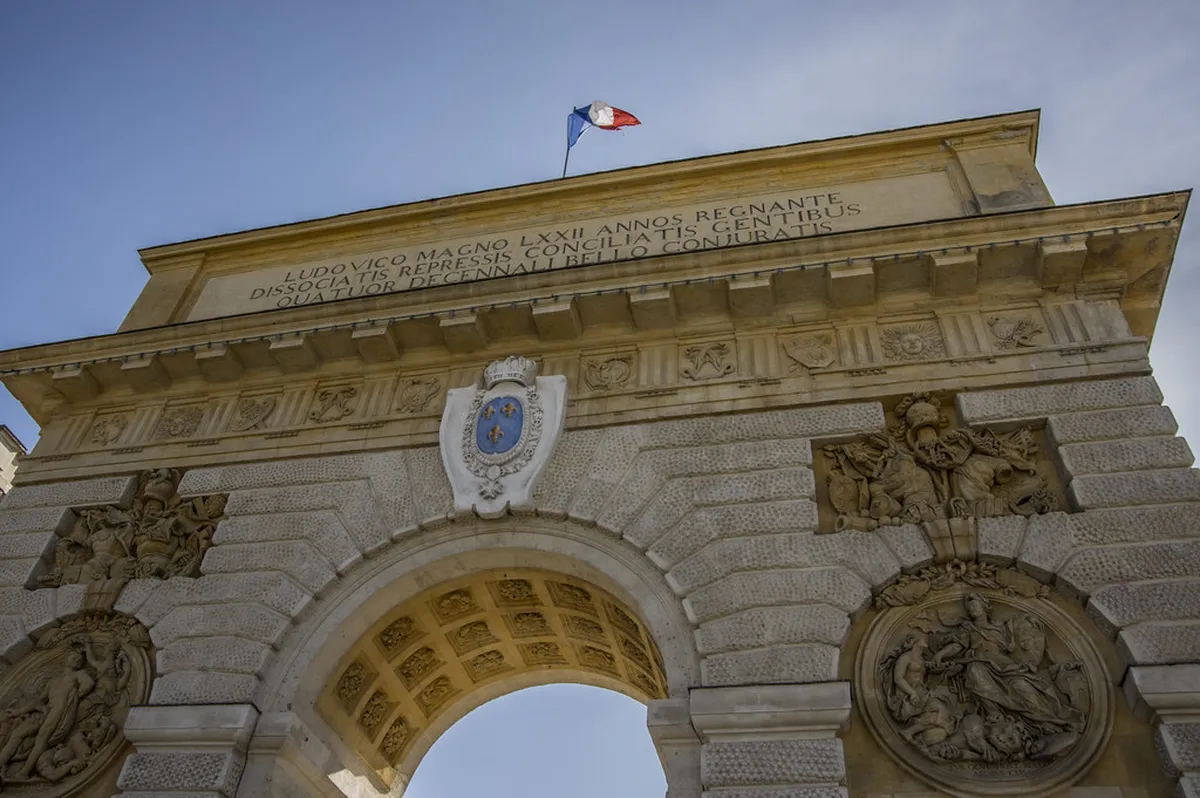
Walk up from the city center and the first thing you encounter is the Porte du Peyrou — a triumphal arch built between 1691 and 1693 to honor Louis XIV. It is modelled on the Porte Saint-Denis in Paris but feels more intimate at street level. The carvings on the attic depict the Sun King's military campaigns, and the keystones show his portrait in profile. You can walk underneath it freely, and the arch frames a perfect long-axis view toward the water tower beyond.
Continue along the central allée and you reach the bronze equestrian statue of Louis XIV at the heart of the square. Cast in the 18th century, it replaced an earlier version melted down during the Revolution. The plinth is high enough that the king surveys the entire esplanade, but the real trick is to stand behind it and look back toward the arch — the alignment is exact and deliberate, the classical axis at its most satisfying.
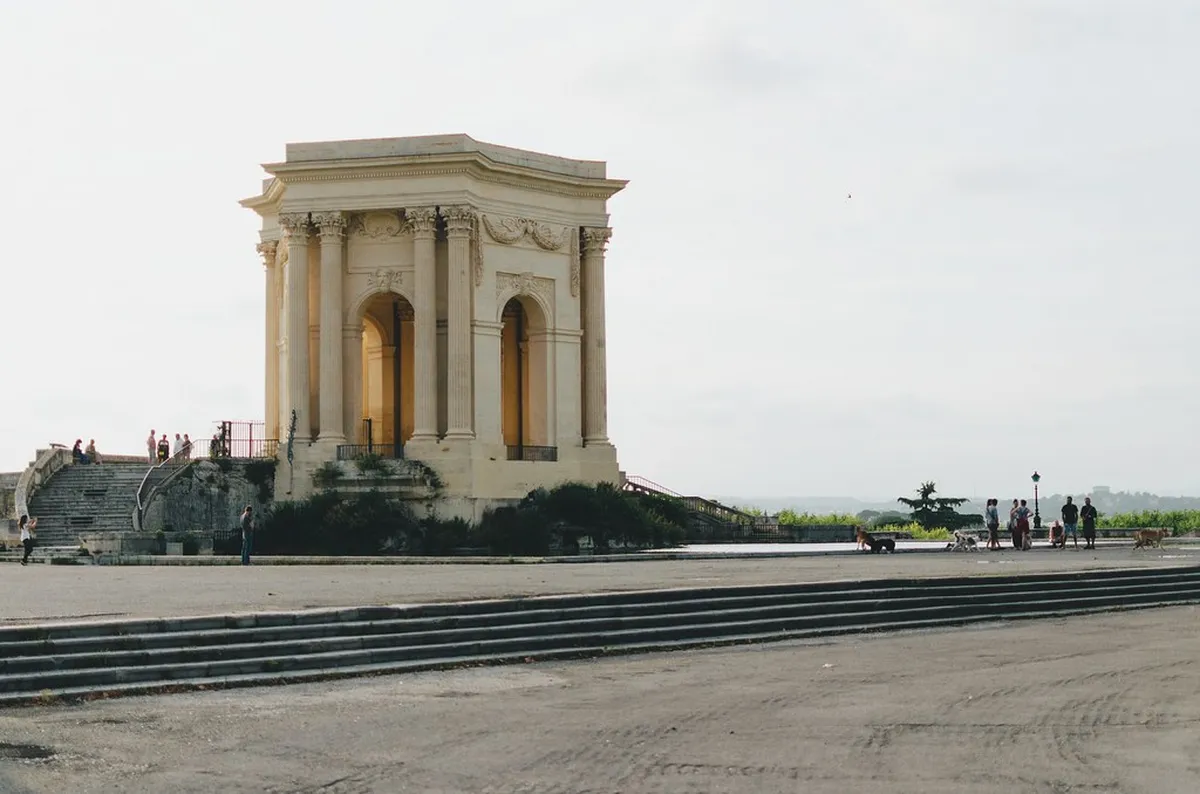
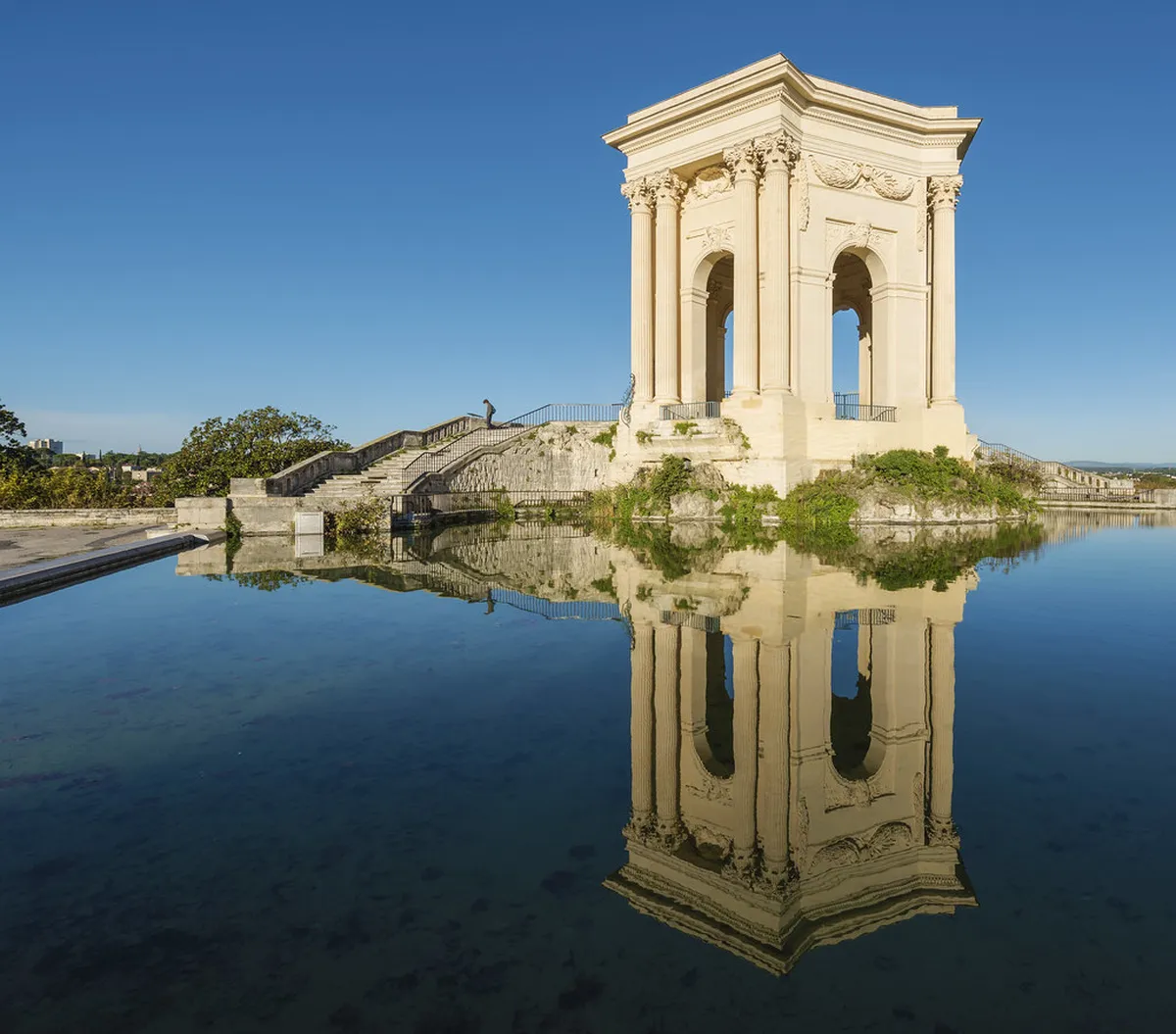
At the western end, the Château d'Eau is the visual terminus of the composition. This hexagonal water tower, ringed by Corinthian columns and topped by a dome, was not built for beauty alone — it was the distribution reservoir that received water from the Saint-Clément Aqueduct and fed the city's fountains. The reflecting pool at its base mirrors the dome and columns on calm mornings. You can find these landmarks and others on our guide to 12 Best Montpellier Attractions and Places to Stay for first-time visitors.
The upper terrace on either side of the central axis offers wide stone balustrades to lean on while taking in the panorama. On a clear day you can pick out the Pic Saint-Loup to the north and the faint glitter of the Étang de Thau to the south. This is the best sunset spot in Montpellier — the western orientation means the sky behind the aqueduct turns orange and pink from about 20:00 in summer.
The Saint-Clément Aqueduct and Les Arceaux
The Saint-Clément Aqueduct is the part of this site that most visitors underestimate. Built between 1753 and 1765 by engineer Henri Pitot — inventor of the pitot tube used in aviation today — it stretches 880 metres from the Château d'Eau down through the neighbourhood of Les Arceaux. The double tier of arches carries a covered channel that once brought water from the Saint-Clément spring, 14 kilometres north of the city.
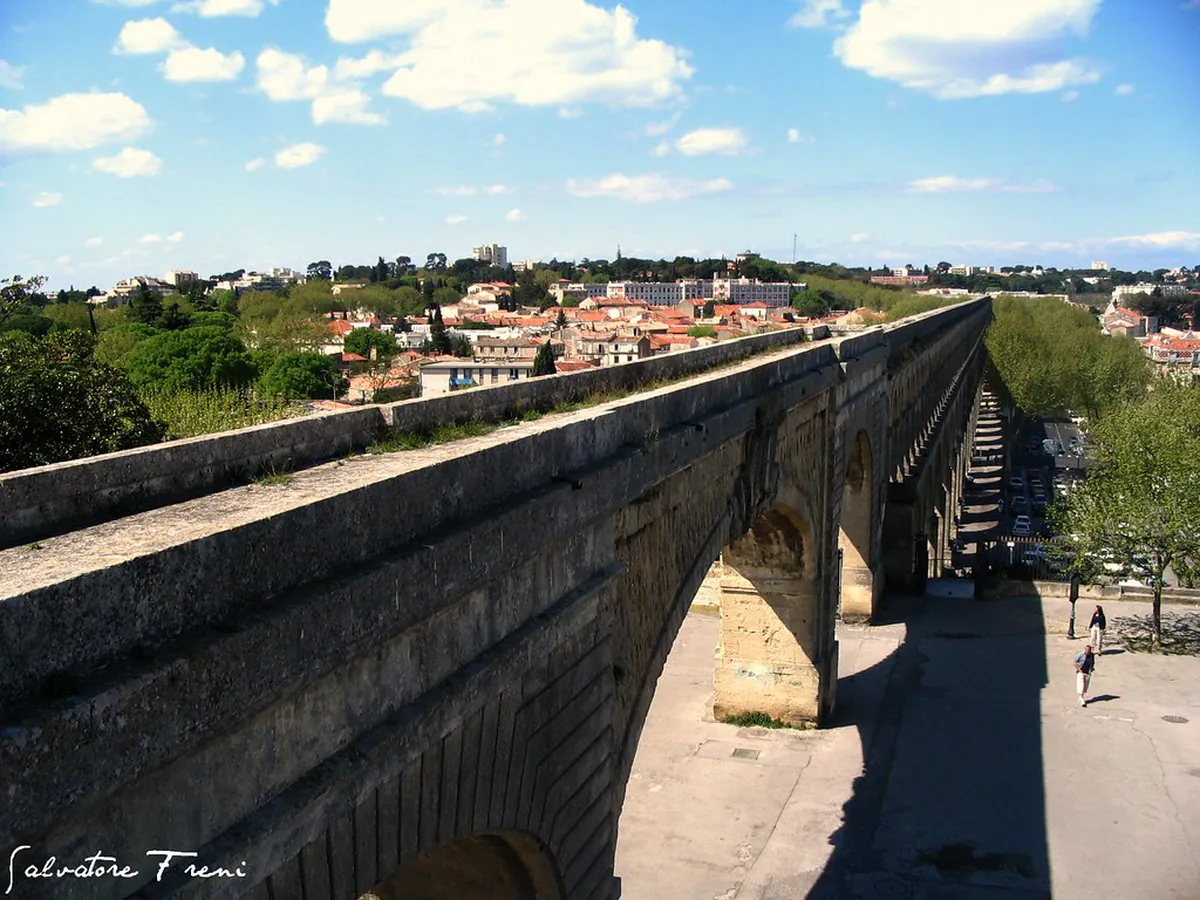
The aqueduct was deliberately designed to echo the Pont du Gard, and the comparison is fair: the proportions are almost identical, the stone is the same honey-coloured limestone, and the shadow play under the arches changes hour by hour. Unlike the Pont du Gard it sits in a residential street, which gives it a completely different mood — you walk along Boulevard des Arceaux with the arches above you, plane trees alongside, and cyclists and joggers passing through.
The best way to experience it is to descend from the Château d'Eau via the north stairs, then walk the full length of the boulevard to its far end. The lower-level arches are tall enough to pass through on foot, and from inside one you get the best architectural photograph of the structure. Early morning light between 07:30 and 09:00 hits the stone from the east and produces long shadows that emphasise the depth of each arch bay.
On most Sunday mornings the antique market sets up along this very boulevard under the aqueduct arches (see the section below). The combination of Roman-style stonework overhead and 70 brocante stalls below is one of the more memorable market experiences in southern France.
Les Dimanches du Peyrou antique market runs every Sunday from 07:30 to 14:30, with up to 70 professional dealers selling genuine vintage pieces. Six times yearly it extends to 17:30 with food stalls — the 2026 schedule includes special editions on March 22, April 26, June 14 (garden furniture focus), September 20, October 18, and December 20.
Les Dimanches du Peyrou: The Sunday Antique Market
Every Sunday morning around 70 professional antique dealers and brocanteurs set up on the Promenade du Peyrou and Boulevard des Arceaux. The market runs from 07:30 to 14:30 and entry is free. This is not a tourist trinket market — dealers here are licensed professionals selling genuine antiques, vintage furniture, ceramics, books, jewellery, and the kind of mid-century French kitchenware that fills design magazines. Arrive before 09:00 if you want the best pieces; serious collectors are there from opening.
Six times a year the market runs as a full-day "journée continue" extending to 17:30, with a themed focus and additional food stalls including food trucks and a guinguette. The 2026 calendar for these special editions is: Grande brocante de printemps on 22 March, Grande brocante vintage on 26 April, Grande brocante mobilier de jardin et poteries anciennes on 14 June (garden furniture and ancient pottery), the 14th anniversary edition on 20 September, Brocante du cinéma on 18 October, and Jouets anciens et arts de la table on 20 December.
The June 14 edition is particularly worthwhile if you are in Montpellier that weekend. The focus on garden furniture and pottery means dealers bring forged-iron salon sets, large terracotta planters, and Provençal faïence that would be hard to find in Paris or Lyon. The extended hours until 17:30 and the food offer make it an entire afternoon outing rather than a quick browse.
When the Market Moves: The 2026 Displacement Calendar
One practical fact that most guides miss: the Sunday market does not always run on the Promenade du Peyrou itself. When the city schedules major events on Boulevard des Arceaux, the market is displaced — dealers set up elsewhere or the market does not run. In 2026 the following Sundays are affected and the market moves off its usual location: 24 May (Comédie du Livre), 31 May (Montpellier Reine), 21 June (Fête de la Musique), 28 June (Festival What a Trip), 5 July (Club Peyrou / Rockstore), 19 July (Swinging Montpellier), 13 September (Beer Love Festival), and from 9 November through 31 December (Marché de Noël occupies the space).
On displaced weeks you can still access the promenade and aqueduct normally — the city events tend to close only part of the boulevard — but if you are specifically planning to visit the antique market, check the official city calendar at montpellier.fr before you go. The 14 June special edition runs as normal because it precedes the June displacement dates.
This is worth flagging for anyone building a weekend itinerary around the market. Arriving on a late-June or July Sunday expecting 70 antique stalls and finding a music festival is a common first-timer disappointment. The good news is that Fête de la Musique and Swinging Montpellier are both excellent alternatives if you happen to be there — the promenade is an atmospheric venue for outdoor concerts.
Outdoor Life: Gardens, Views, and Petanque
The Promenade du Peyrou connects directly to one of France's oldest botanical gardens. You can follow our 6 Essential Tips for Visiting Jardin des Plantes Montpellier to walk from the promenade's eastern end into the garden in under five minutes. The contrast is immediate — from open limestone esplanade into dense, shaded paths lined with specimen trees planted since 1593. Together the two sites make a full half-day loop that costs nothing and covers several centuries of French horticulture and urban planning.
The plane trees lining the central allée of the promenade are among the oldest in Montpellier, providing deep shade by mid-morning. Benches run the length of the allée, and in the early evening locals occupy nearly every one. You will regularly see pétanque games in progress on the sandy lower terrace — the surface is ideal for it, and no one objects to spectators. Bring a baguette and some local cheese from the Halles Castellane nearby and you have a proper Montpellier picnic spot.
Sunrise is underrated here. The esplanade faces west for sunset but the aqueduct catches the eastern light at dawn, and the market crowd has not arrived yet. Joggers use the flat upper terrace as a circuit, and the air is cooler than anywhere in the old town. Early morning is also the best time to photograph the Château d'Eau without other people in the frame.
Family-Friendly and Free: Visiting on Any Budget
The promenade costs nothing to enter and has no restricted areas or timed entry. It is consistently listed among the top 15 Best Free Things to Do in Montpellier for exactly this reason. Wide, car-free paths make stroller and wheelchair access straightforward across most of the upper terrace, and the city has installed ramps connecting the different levels. The flat, paved surfaces make it one of the most accessible historic sites in the city.
For families with children, the open space is a relief after navigating the narrow streets of the Écusson. Kids can run across the full width of the esplanade without any traffic hazard. The sundial features on the upper terrace are a genuine curiosity for older children — the hour lines are inlaid in the stone and still accurate. On Sunday market days, children often gravitate toward the vintage toy stalls where dealers bring clockwork trains, tin cars, and ceramic figurines from the 20 December "Jouets anciens" edition.
Cafés immediately adjacent to the park keep prices reasonable because the tourist flow here is local as much as international. A coffee and croissant before the market opens costs the same here as at a neighbourhood bar. Public water fountains on the esplanade are refillable, and restrooms are available near the Arc de Triomphe entrance.
Getting There and Planning Your Visit
Tram lines 4 and 5 stop at Peyrou – Arc de triomphe, which is the main entrance to the promenade. Bus line 6 serves the same stop. The journey from the central Place de la Comédie takes about eight minutes by tram. There is no need to drive — nearby car parks at Pitot, Préfecture, Gambetta, and Corum exist but fill quickly on Sunday mornings when the market runs. Bike racks are available at the market entrance for cyclists arriving via the aqueduct boulevard.
Allow one to two hours for the promenade and aqueduct walk if you are not visiting the market. Add 90 minutes minimum if the Sunday market is running. The site is open at all hours every day of the year. Sunset visits run roughly 20:00–21:00 in summer and 17:00–18:00 in winter — the western orientation means the Château d'Eau and aqueduct glow in late afternoon light regardless of season.
The Promenade du Peyrou is Montpellier's best sunset spot. The western orientation means the sky behind the aqueduct and water tower turns orange and pink from around 20:00 in summer, creating perfect photography light on the limestone arches.
The elevated position means wind is a constant factor, stronger than anywhere else in the city center. Even on still days a breeze comes off the plateau. A light layer in spring and autumn is not overcaution — the limestone surface amplifies both heat and cold depending on the season. In July and August arrive before 10:00 or after 17:00 to avoid the hottest hours on an exposed stone terrace.
Accessibility information including sign-language service details is available from the city's tourism office at the main entrance. The official tourism page at montpellier-tourisme.fr lists current event schedules and any temporary closures. Always check before a Sunday visit to confirm the market is not displaced by a city event — see the 2026 displacement calendar in the section above.
What to See Nearby: Flaugergues and Beyond
The Château de Flaugergues is the most rewarding half-day excursion from the promenade. This 17th-century "folie" — a country estate built by a wealthy magistrate — sits 4 kilometres east of the city center and is reachable by tram (line 1, stop Croix d'Argent, then a short walk) or by car. The estate produces its own wine, offers guided tours of the furnished interior (Flemish tapestries, original 18th-century furniture), and keeps its formal garden immaculately. It appears on most lists of the 10 Best Day Trips From Montpellier: The 2026 Travel Guide precisely because it pairs well with a morning at the promenade — the two sites together trace Montpellier's aristocratic history from royal square to private estate.
Closer at hand, the Saint-Pierre Cathedral is a 10-minute walk east through the old town. Its porch canopy supported on two cylindrical towers is one of the most unusual Gothic facades in France, built by the Benedictines as a statement of authority in a city with a strong Protestant minority. The interior is cool and relatively uncrowded even in summer. Combined with the promenade, the botanical garden, and a stop at the Halles Castellane market, it makes a coherent full day in Montpellier without booking anything in advance or spending money on entry fees.
For those staying overnight, the Écusson neighborhood — the medieval old town directly downhill from the Arc de Triomphe — has the best density of independent restaurants, wine bars, and boutique accommodation. The walk back from the promenade at dusk, through the narrow lanes with their sandstone facades lit by streetlamps, is one of the more pleasurable ten minutes you will spend in this city.
Quick facts: see our attraction pages for the Promenade du Peyrou and the Aqueduc Saint-Clément.
Frequently Asked Questions
Which promenade du peyrou montpellier options fit first-time visitors?
First-time visitors should prioritize the Arc de Triomphe and the water tower for the best experience. These landmarks offer the most historical value and incredible photo opportunities. You can easily include these in a Montpellier 3-day itinerary for a complete city overview.
How much time should you plan for promenade du peyrou montpellier?
Plan for at least one to two hours to walk the grounds and admire the views. If you visit during the Sunday antique market, you may want to stay for three hours. The park is best enjoyed at a slow pace to appreciate the architectural details.
What should travelers avoid when planning a visit?
Avoid visiting during the hottest part of the afternoon in July or August as shade is limited. Travelers should also be wary of visiting during high wind alerts, as the terrace is very exposed. Always check for local event closures to avoid disappointment upon arrival.
Is the promenade accessible for people with disabilities?
Yes, the city has installed ramps to ensure all levels of the promenade are accessible. There are also specific services like 'Menu Service LSF' for those with hearing impairments. The flat, paved paths make it one of the most accessible historic sites in the city.
The promenade du peyrou montpellier remains an essential stop for anyone visiting the south of France. It perfectly captures the elegance of the past while remaining a vibrant part of modern city life. Whether you come for the history, the markets, or the views, it never fails to impress.
Taking the time to walk the full length of the Saint-Clément Aqueduct and then returning to the upper terrace for sunset gives you the full scope of what makes this site exceptional. The Sunday market adds another layer entirely — but check the displacement calendar first so you are not surprised. Plan your visit to coincide with sunset for a truly unforgettable experience in this historic city.
As you leave the promenade, the rest of the city's treasures are just a few steps away. The mix of old-world charm and modern energy makes this destination a favorite for travelers worldwide. We hope this guide helps you make the most of your time in this stunning Mediterranean jewel.
Free guide: France's Hidden Gems
12 under-the-radar places across Provence, Alsace & Occitanie — with the best season to visit each and a local tip you won't find in the guidebooks.
You might also like


Continue reading
More guides you'll find useful


