10 Things to Know Before Visiting the European Parliament in Strasbourg
Plan your visit to the European Parliament in Strasbourg with our guide to the Hemicycle, plenary session calendars, security tips, and district highlights.
On this page
10 Things to Know Before Visiting the European Parliament in Strasbourg
Strasbourg is the official seat of the European Parliament and the city most associated with the idea of a united Europe. The Parliament represents around 450 million citizens across 27 member states. Visitors can enter the building, watch debates from the public gallery, and explore a free interactive museum — all without paying a euro. Understanding how this site actually works helps travelers decide if is Strasbourg worth visiting for their next trip.
The Significance of the European Parliament in Strasbourg
Strasbourg was chosen as the seat of the European Parliament because of what the city represents: a border town that changed hands between France and Germany multiple times before becoming a symbol of reconciliation. After World War II, placing the new European institutions here sent a deliberate message about the continent's future direction. That choice has defined the city's identity ever since.
In 1949, Strasbourg became the seat of the Council of Europe. The European Parliamentary Assembly followed in 1958, and it was renamed the European Parliament in 1962. The Parliament has grown from a nominated assembly into the largest directly elected legislative body in the world, now holding 705 members who serve five-year terms. For more on the institution's evolution, see the full institutional history on Wikipedia.
Today the institution holds legislative, budgetary, and supervisory powers over the European Union. Twelve plenary sessions per year bring all members to Strasbourg to debate and vote on European law. The city is also home to the Council of Europe, the European Court of Human Rights, and several other EU bodies, making the Wacken district the densest concentration of international institutions outside of Brussels.
Architecture of the Louise Weiss Building: A Symbol of Transparency
The Louise Weiss building opened in 1999 and was designed by Architecture Studio, a French practice known for large civic projects. The structure is elliptical, shaped like a ship with its prow cutting through the water of the Ill River. Its glass facade spans 13,000 square metres and is deliberately transparent — a visual statement about open democratic governance.
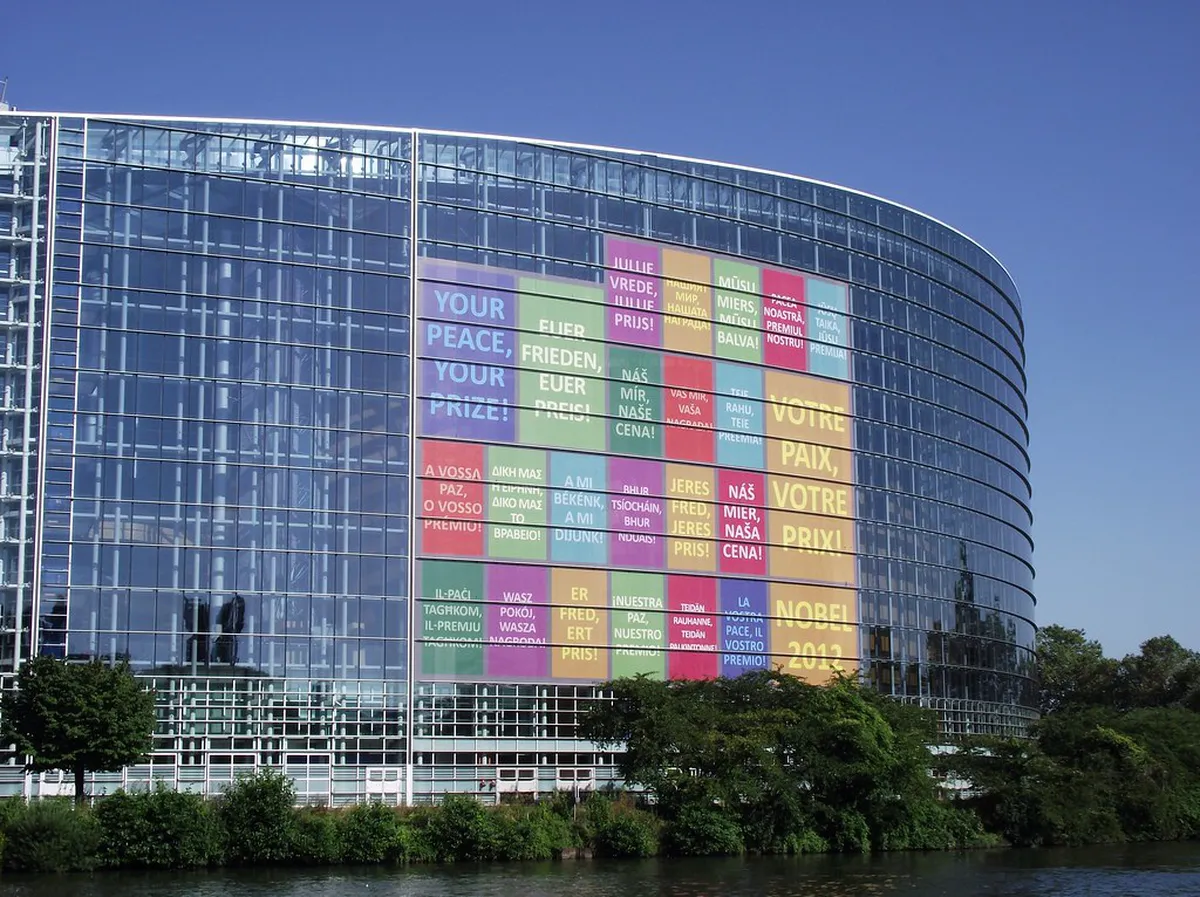
The tower rises 60 metres and its top is intentionally left unfinished. This design choice is not accidental: it symbolises that the European project is a perpetual work in progress, never truly complete. That single architectural decision is the most-discussed feature of the building and the one that most visitors photograph first.
Inside, the building covers 220,000 square metres across 20 floors. It contains the Hemicycle chamber with more than 750 seats, 1,133 offices, and 18 committee rooms. The internal courtyard is a masterpiece of curved lines, flooded with natural light. Walking through the main avenue — designed as a winter garden with a dense planting of philodendrons — gives the interior a surprisingly warm atmosphere for a political institution.
Visiting the Hemicycle and Parlamentarium Simone Veil
Entry to the European Parliament is free, and no prior booking is required for individual visitors. Outside plenary sessions, the building is open Monday to Friday from 09:00 to 18:00 (last admission 17:00) and Saturday from 09:30 to 12:00 and 13:00 to 18:00. During a plenary week, hours shift slightly and access to the Hemicycle from the public gallery is allocated on a first-come, first-served basis with a maximum stay of one hour per visitor.
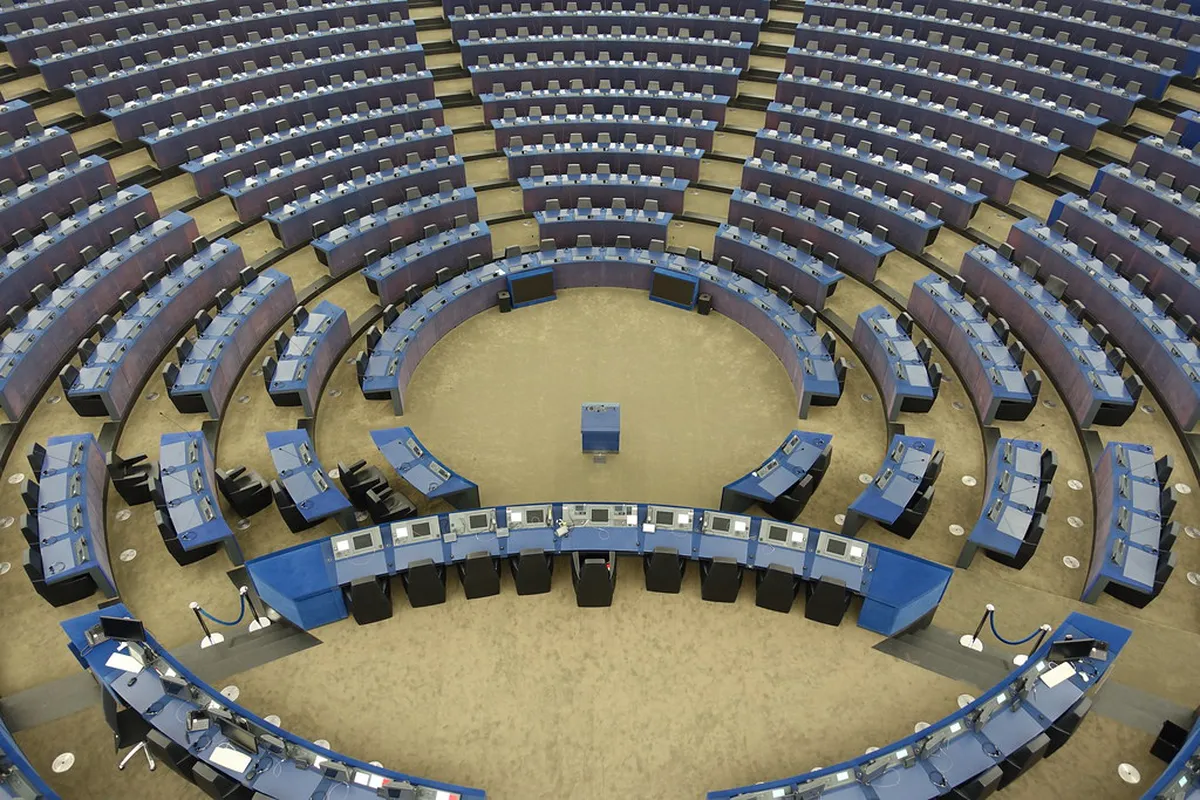
The Hemicycle is the largest parliamentary chamber in Europe, with seating for more than 750 members arranged in a semicircle. The public gallery sits above the floor and gives a clear view of the full chamber. During a session you can listen to live simultaneous translation in all 24 official EU languages through headsets provided at your seat.
Every visit also includes the Parlamentarium Simone Veil, a permanent interactive exhibition that explains how the Parliament works and how EU decisions affect daily life. It uses 360-degree cinema screens, touchscreen tables, and documentary material to trace the history of European integration. Most visitors spend 60 to 90 minutes here. Check the official visiting portal to confirm session dates and any temporary closures before your visit.
The Parlamentarium Simone Veil is entirely free to visit. Entry opens Monday to Friday 09:00–18:00 (until 17:00 final admission) and Saturday 09:30–12:00 and 13:00–18:00. You must bring an original ID document (passport or national ID card) — photocopies and digital copies are not accepted. During plenary weeks (typically Monday–Thursday, twelve times annually), the Hemicycle is accessible to gallery visitors on a first-come, first-served basis with a one-hour maximum stay.
After the Parliament, consider extending your day with a stop at the Alsace-Moselle Memorial, a short drive south near Schirmeck. It documents the region's unique history of shifting between France and Germany, and provides an emotional counterpart to the forward-looking optimism of the Parliament buildings.
Security Checklist: What to Bring and What to Expect
Security at the European Parliament is airport-style and it catches many first-time visitors off guard. You pass through metal detectors and your bags go through an X-ray scanner. The process takes around 10 to 15 minutes during busy periods, so arrive earlier than you think you need to — particularly on session days when queues build quickly from the morning.
The single most common reason for being turned away at the entrance is ID. You must carry an original, physical identity document — a passport or a national ID card. Photocopies are not accepted. Photographs of your passport on your phone are not accepted. Digital EU Digital Identity Wallet credentials are not currently accepted at the physical security desk. This rule applies to all visitors regardless of age or nationality.
Large bags and luggage are not permitted inside the building. Leave wheeled suitcases at your hotel or in a luggage locker at Strasbourg's main station. Water bottles, food, and umbrellas are generally fine to carry in once they have cleared the scanner. Staff are helpful and multilingual, so if you are unsure about an item, ask at the security desk before queuing.
Other Key Institutions: Council of Europe and the ECHR
The Palais de l'Europe, inaugurated in 1977, has been the seat of the Council of Europe since that year. French architect Henry Bernard designed it in a deliberately powerful style: the building's mass and the long row of 46 member state flags in front convey institutional weight. It sits on the edge of the Orangerie Park, which makes the walk from the Parliament to the Palais an easy and pleasant ten-minute stroll. The Council of Europe is separate from the European Union — it has a broader mandate covering human rights and democracy across 46 nations.
The European Court of Human Rights stands beside the Palais de l'Europe. Sir Richard Rogers designed its two futuristic metal cylinders to represent the scales of justice. The glass entrance facade signals the transparency of legal proceedings. The building opened in 1995 and is accessible to 800 million Europeans. Visiting the exterior gives you a strong sense of scale, and the architecture alone justifies the walk.
For group visits to the Council of Europe, contact the Council of Europe Visitors Service in advance. These buildings make the Wacken district a living textbook for anyone interested in international law or European diplomacy. Seeing them in person helps you understand what is Strasbourg famous for at a deeper level than the cathedral alone.
Exploring the European District: Parks and Culture
The Lieu d'Europe, housed in an elegant 18th-century mansion on the edge of the institutional district, is the best starting point for understanding the whole area. It runs free exhibitions, debates, film screenings, and events on European themes throughout the year. Unlike the Parliament building itself, it offers a human-scale, unhurried environment where you can sit with the material and absorb it at your own pace. None of the larger visitor centres in the district match it for context and atmosphere.
The Parc de l'Orangerie sits directly across from the Parliament and is the oldest park in Strasbourg. It has formal flower gardens, a boating lake, and a stork reserve. In spring and early summer, white storks nest here in visible colonies — a sight that is genuinely hard to find in a European capital. The park is a natural rest stop between the Parliament and the Council of Europe.
The Arte television headquarters and the European Pharmacopoeia building are both in the district and add an interesting architectural dimension to a walking tour. The Arte building by architect Hans Struhk incorporates two internal courtyards and a hanging garden. None of these buildings charges admission and all are visible from public paths along the Ill River.
Plenary Session Calendar: When to Visit (and When to Avoid)
The Parliament holds twelve plenary sessions per year in Strasbourg, typically one per month from January to July and September to December. Each session runs Monday to Thursday. During these four days, the entire political machinery of the European Parliament — 705 MEPs, thousands of staff, lobbyists, and accredited press — moves from Brussels to Strasbourg simultaneously. The city calls this rhythm "the traveling circus," and the nickname captures both the spectacle and the disruption it causes.
The practical consequence for visitors is sharp. Hotel prices in Strasbourg routinely triple during plenary weeks, and accommodation within a kilometre of the Parliament sells out weeks in advance. Restaurants in the Wacken district fill with political staff by noon. If your goal is to watch a session from the gallery, book your hotel the moment session dates are published — usually several months before. If your goal is a relaxed, affordable sightseeing visit, plan for any week when Parliament is in recess, including the full August summer break.
- Visiting during a session: you can watch live debates from the public gallery, the city has an unusual energy, but hotels are expensive and must be booked far in advance.
- Visiting outside a session: quieter building access, lower hotel prices, no gallery access to a live debate, but the Parlamentarium and Hemicycle are still fully open and free.
The European Parliament holds twelve plenary sessions per year in Strasbourg, running Monday to Thursday for four days each. Sessions typically occur once per month from January to July and September to December (August is the summer recess). Each session week brings 705 MEPs and thousands of staff to the city, causing hotel prices to triple and accommodation to sell out weeks in advance. For budget-conscious visitors planning a relaxed sightseeing trip, avoid plenary weeks and visit when Parliament is in recess. Check the official plenary calendar before booking your travel dates.
The full plenary calendar for 2026 is published on the European Parliament's official website. Always check it before finalising your travel dates regardless of which experience you prefer.
Getting to and Around the European District
Tram Line E is the most direct route to the Parliament. Take it to the "Parlement Européen" stop, which deposits you at the main entrance. Trams run every 6 to 10 minutes from the city centre, and the journey from Place de l'Homme de Fer (the central interchange) takes around 12 minutes. The fare is a standard CTS network ticket, currently around €1.80 for a single journey in 2026.
Tram Line H also serves the "Parlement Européen" stop and runs a more direct route from the main train station (Gare Centrale). If you are arriving from another French city by TGV, Line H is the fastest connection: the Parliament is about 20 minutes door-to-door from the station platforms. Bus lines 6, 30, and 72 serve the nearby "Droits de l'Homme" stop, which is a 10-minute walk from the Parliament entrance.
If you are arriving from Strasbourg Airport, check our Strasbourg airport guide for the shuttle train schedule into the city centre. From there, connect to tram Line E or H. Walking from the historic centre takes about 30 minutes along the Ill River via a flat, well-marked path that passes through several parks. Cycling is also practical — the district is fully served by bike lanes and there are Vélhop rental stations near the Parliament entrance.
Itinerary Planning: 1, 2, and 3 Days in Strasbourg
On a single day, start at the Lieu d'Europe for context, then walk to the Parliament for the Parlamentarium and Hemicycle, continue to the Palais de l'Europe and the ECHR exterior, and finish with a circuit through the Orangerie Park. This loop takes four to five hours at a reasonable pace. If Parliament is in session that day, arrive by 09:00 to secure a gallery slot before they fill.
Two days gives you the freedom to mix the European District with the medieval city centre. Follow a Strasbourg 2-day itinerary to pair the Parliament visit with the cathedral, Petite France, and the half-timbered houses of La Neustadt. The contrast between the city's ancient Alsatian character and its modern institutional identity is what makes Strasbourg genuinely different from other French cities.
Three days or more opens up the wider Alsace region. You can find plenty of things to do in Strasbourg beyond the institutional district — wine routes, half-timbered villages, and the Alsace-Moselle Memorial all reward extra time. The city works well as a base for day trips northeast into Germany or south toward Colmar.
Practical Tips: Strasbourg City Card and Budget Advice
Entry to the European Parliament — including the Parlamentarium Simone Veil — is completely free. This makes it one of the most substantial free visitor experiences in France, especially given the quality of the interactive exhibitions. You do not need to book in advance for an individual visit outside of session weeks. Groups of ten or more must reserve online several weeks ahead through the Parliament's official visitors service.
The Strasbourg City Card provides unlimited tram and bus travel plus discounts on boat tours and several paid museums. It is available for 24 hours (€13.90), 48 hours (€20.90), or 72 hours (€26.90) and can be purchased at the tourism office near Place de la Cathédrale or at the main train station. If you are combining the European District with three or more paid attractions, the 48-hour card typically pays for itself within the first day.
For more logistics, read our Strasbourg practical tips guide before you travel. Budget meals in the European District are harder to find during plenary weeks — local staff fill the nearby cafes by midday. For cheaper lunches, walk ten minutes south toward the Robertsau neighbourhood where sandwich bars and bakeries cater to local workers rather than political delegations.
Accessibility and Visiting with Reduced Mobility
The Louise Weiss building is fully accessible for visitors with reduced mobility. Ramps and lifts serve all publicly accessible floors, including the Hemicycle gallery and the Parlamentarium. Accessible parking bays are available in the car park directly adjacent to the main entrance on allée du Printemps. Tram Line H is a low-floor service, which makes the journey from the station accessible for wheelchair users without any step access.
Multimedia guides for the self-guided tour of the Parlamentarium are available in all 24 EU official languages and include audio-description options for visitors with visual impairments. Staff at the information desk can arrange adapted tours for groups with specific mobility or sensory needs, provided these are requested at least two weeks in advance through the visitors service portal.
The Orangerie Park next door has wide, sealed paths throughout and is fully navigable by wheelchair. The Lieu d'Europe also has step-free access at its main entrance. The entire institutional district was built to modern accessibility standards and is considerably easier to navigate with mobility aids than the historic city centre, where cobblestones and narrow medieval lanes present more challenges.
See our main Strasbourg attractions guide for the broader overview.
For more Strasbourg ideas, see our guides to an Obernai day trip.
Frequently Asked Questions
How do I book a visit to the European Parliament in Strasbourg?
Individual visitors do not usually need to book in advance for the Parlamentarium or Hemicycle. You can simply arrive during opening hours with a valid ID. However, groups of 10 or more must reserve a slot online several weeks before their planned visit.
Can you visit the European Parliament when it is not in session?
Yes, you can visit the European Parliament throughout the year even when sessions are not happening. These days are often quieter and allow for a more relaxed tour of the facilities. Check the official calendar to see which days the building is open to the public.
Is the European Parliament in Strasbourg worth visiting?
It is absolutely worth visiting for anyone interested in architecture, history, or international politics. The site offers a unique look at how 27 countries work together to shape European laws. Families can also find useful tips in our Strasbourg with kids family guide for this area.
What is the difference between the European Parliament in Brussels and Strasbourg?
Strasbourg is the official seat where the full Parliament meets for monthly plenary sessions and major votes. Brussels is where the committees meet and where most of the daily political work occurs. Both locations offer visitor centers, but Strasbourg holds the primary symbolic importance.
Visiting the European Parliament in Strasbourg offers a fascinating glimpse into the democratic heart of Europe.
From the glass architecture to the historic debates, the district provides a unique experience for every traveler.
Plan your trip carefully around the session calendar to balance your budget and your interests.
Exploring this modern landmark will give you a deeper appreciation for the city's role on the world stage.
You might also like


Continue reading
More guides you'll find useful