

Grande Île, Strasbourg: UNESCO Historic Centre Guide (2026)
The Grande Île — literally the "Big Island" — is the historic heart of Strasbourg, an oval of streets and squares cradled between the two arms of the River Ill. This is where the city began, and it remains its centre of gravity: the soaring sandstone cathedral, the half-timbered lanes of Petite France, the grand shopping square of Place Kléber, and the riverside Palais Rohan all sit within its compact, almost entirely pedestrian core. In 1988 the Grande Île became the first entire city centre ever inscribed on the UNESCO World Heritage List, and in 2017 the listing was extended to take in the neighbouring Neustadt. Best of all, the island itself is completely free to explore — there is no ticket and no closing time, just a medieval-to-Renaissance townscape made for walking. This 2026 guide covers why it earned World Heritage status, what to see, how to walk it, and how to arrive by tram.
Why It's UNESCO-Listed
The Grande Île was added to the UNESCO World Heritage List in 1988, a landmark decision because it was the first time an entire historic city centre — rather than a single monument — had been inscribed in its own right. UNESCO recognised the island as an outstanding example of a medieval and Renaissance Rhineland city, an exceptionally complete ensemble structured around its great Gothic cathedral, with winding streets, half-timbered houses, and the canals of the Ill all preserved together. In 2017 the inscription was extended to include the adjacent Neustadt ("new town"), the broad German-imperial district laid out between 1871 and 1918, so that the official World Heritage property is now named "Strasbourg, Grande-Île and Neustadt" and covers around 182 hectares.
What makes the site so distinctive is the way two architectural worlds meet around a single landmark. The medieval Grande Île, with the cathedral at its core, and the Haussmann-influenced yet Germanic Neustadt together form a continuous urban landscape that traces the city's history at the crossroads of French and German culture. For visitors, that means the island is not a single attraction but a living, walkable museum of European city-building, where almost every street has a story.
What's on the Island
The undisputed centrepiece is Strasbourg Cathedral (Cathédrale Notre-Dame), a masterpiece of Gothic architecture in pink Vosges sandstone whose single spire — completed in 1439 — made it the tallest building in the world until the 19th century. Its astronomical clock, carved façade, and tower platform are highlights, and the cathedral is free to enter, with a small charge for the platform and the clock show.
At the western tip of the island lies Petite France, the postcard-perfect former quarter of tanners, millers, and fishermen, where half-timbered 16th- and 17th-century houses lean over the canals beside the Ponts Couverts (Covered Bridges) and the Barrage Vauban. Toward the centre, Place Kléber is the island's largest square and main meeting point, ringed by shops and presided over by the statue of General Kléber. A short walk away, the elegant Place Broglie hosts the opera house and the famous Christmas market, while the riverside Palais Rohan — an 18th-century episcopal palace — now holds the Museum of Fine Arts, the Archaeological Museum, and the Decorative Arts Museum. Scattered between them are landmark churches including the Protestant Église Saint-Thomas (with its Silbermann organ played by Mozart and Albert Schweitzer) and Saint-Pierre-le-Jeune, plus the medieval Maison Kammerzell beside the cathedral and the lively shopping spine of the Rue des Grandes Arcades.
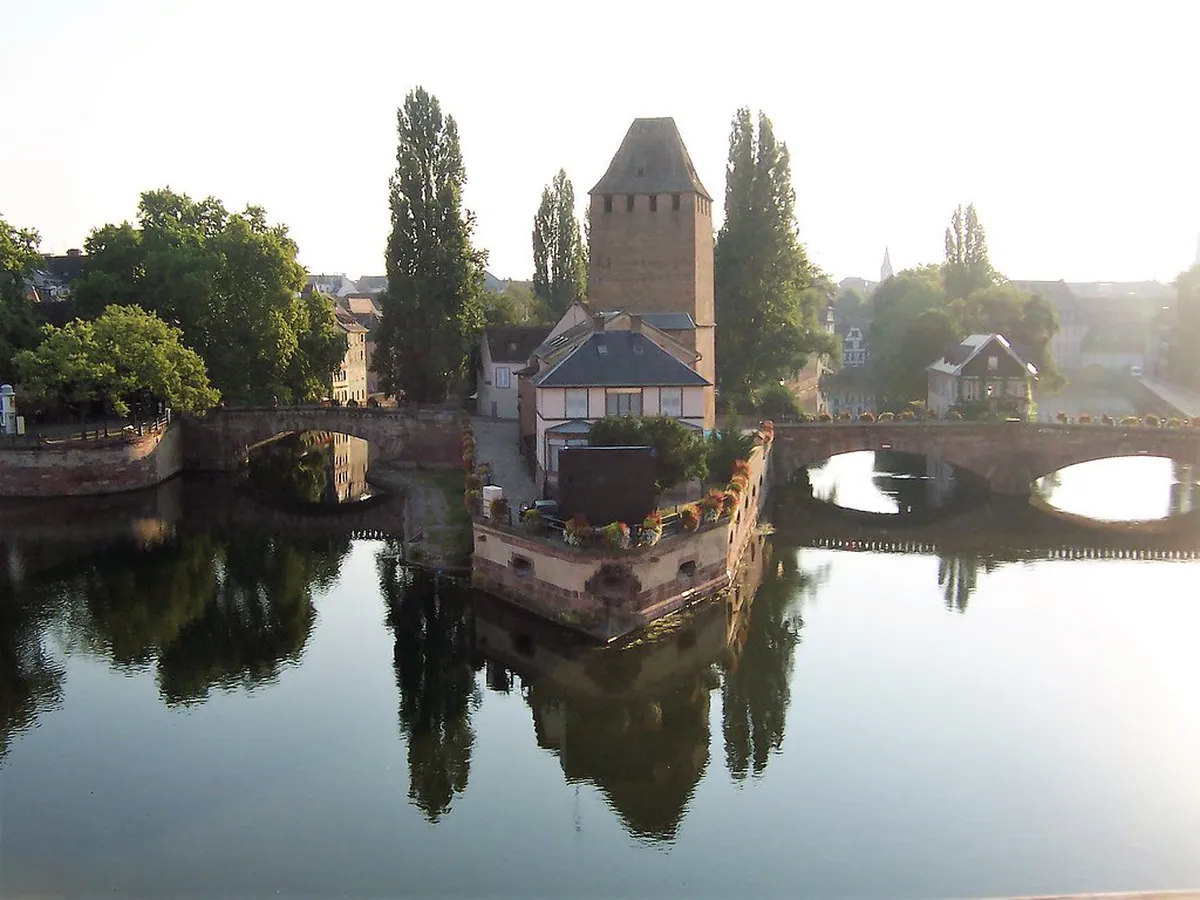
Walking the Grande Île
The island is best treated as one long, unhurried walk rather than a checklist. Measuring only about a kilometre across, the Grande Île is almost entirely pedestrianised, so cars are kept to the edges and the streets belong to walkers, cyclists, and café terraces. A natural route runs from Place Kléber south to the cathedral, then along the Rue Mercière for the classic framed view of the spire, before drifting west through the lanes toward Petite France and the Ponts Couverts.
Along the way you will cross the Ill several times on low stone bridges, pass the Palais Rohan on its terrace above the water, and stumble onto small squares such as Place du Marché-Gayot that open up like hidden rooms. Distances are short — you can stroll from one end of the island to the other in fifteen or twenty minutes — but it rewards lingering, with winstubs (Alsatian taverns), patisseries, and bookshops tucked into the timber-framed houses. The cobbles are uneven in places, so comfortable shoes help. A relaxing alternative is the Batorama boat tour, which loops the island's canals and explains the architecture from the water. The streets themselves are public, free, and open at all hours, though the museums, churches, and shops keep their own daytime opening times.
Getting There
The Grande Île sits at the very centre of Strasbourg, and the easiest way to reach it is by tram. The hub of the network is Homme de Fer, the busy interchange just off Place Kléber where five of the city's six tram lines meet — step off here and you are already on the island. For the cathedral and Petite France end, the Langstross/Grand'Rue stop (lines A and D) drops you right into the southern lanes, while Broglie (line B/C/F) serves the Place Broglie and the museums. From Strasbourg's main railway station (Gare Centrale), it is a short tram ride on line A, C, D, or F, or a ten-minute walk east across the Ill.
Because the island is pedestrianised, there is no need — and little possibility — to drive into its core; leave any car in a park-and-ride (relais-tram) on the outskirts and complete the trip by tram. Once on the Grande Île, everything is within easy walking distance. For where the island fits into a wider visit, see our things to do in Strasbourg guide and our things to see in Strasbourg overview.
Nearby
The Grande Île is so central that almost everything in Strasbourg is within reach of it. At the island's western tip, the Petite France quarter and its covered bridges flow straight into the riverside walk along the Ill. Cross the canals to the south and you enter the German-era Neustadt, with its grand avenues, the Palais du Rhin, and the monumental Place de la République — the 2017 extension to the World Heritage site.
To the east, beyond the historic centre, lie the gleaming European institutions — the European Parliament and the Council of Europe — easily reached by tram. Combine a morning on the Grande Île, taking in the cathedral and Petite France, with an afternoon drifting through the Neustadt or a canal-boat loop, for a full and satisfying day in Strasbourg's UNESCO core.
Frequently Asked Questions
Is the Grande Île free to visit?
Yes. The Grande Île is Strasbourg's public historic centre, so walking its streets, squares, and canalside paths is completely free, with no ticket and no opening hours. You only pay if you choose to climb the cathedral platform, enter the Palais Rohan museums, or take a canal-boat tour.
Why is the Grande Île a UNESCO World Heritage Site?
The Grande Île was inscribed by UNESCO in 1988 as the first entire city centre ever listed, recognised as an outstanding medieval and Renaissance Rhineland townscape structured around its Gothic cathedral. In 2017 the listing was extended to include the neighbouring Neustadt, so the official site is now "Strasbourg, Grande-Île and Neustadt", covering about 182 hectares.
How do I get to the Grande Île by tram?
Take the tram to Homme de Fer, the central interchange where five of Strasbourg's six tram lines meet, just off Place Kléber on the island itself. For the cathedral and Petite France end, use the Langstross/Grand'Rue stop; for the museums and opera, use Broglie. The island is pedestrianised, so arrive by tram or on foot rather than by car.
Explore More of Strasbourg
- Things to Do in Strasbourg — the full city guide.
- Things to See in Strasbourg — the city's landmark sights at a glance.
- Petite France — the half-timbered tanners' quarter at the island's western tip.


