Koïfhus (Ancienne Douane), Colmar: Old Customs House Guide (2026)
Visit the Koïfhus (Old Customs House) in Colmar: a 1480 landmark with a glazed-tile roof, Grand'Stube hall, and free square to explore.
On this page
The Koïfhus — also known as the Ancienne Douane, or Old Customs House — is the oldest public building in Colmar and one of the most striking landmarks in the city's Alsatian old town. Completed in 1480, it served for centuries as the hub of Colmar's trade and political life: a customs post where goods were taxed below and, on the first floor, the grand Grand'Stube hall where the assemblies of the Décapole league of ten imperial cities once met. Today its polychrome glazed-tile roof and carved stone balustrade rise over Place de l'Ancienne Douane, a free public square that is a natural stop on any list of things to do in Colmar. This 2026 guide covers its history, architecture, the square and markets around it, and how to get there.
History (1480)
The Koïfhus is the oldest public building in Colmar. Conceived in the 1430s, the structure as it stands today was finished in 1480 — a date recorded on a southern gable by a carved angel holding a parchment. Its name comes from the German Kaufhaus ("trading house"), reflecting its dual role at the heart of a prosperous free imperial city: the ground floor functioned as a customs house and storehouse where merchandise was weighed, stored and taxed before it could be sold.
The building was far more than a warehouse, however. Its upper floor was the political nerve centre of Colmar and of the wider region. It hosted the assemblies of the Décapole, the federation of ten Alsatian imperial cities that banded together from 1354 until 1679 for mutual defence and shared interests. The coats of arms of the Décapole cities still decorate the upper windows. Colmar's own tribunal and municipal council also met here, making the Koïfhus the single most important secular building in the medieval city. It was classified as a monument historique in 1930 and remains a protected national landmark in 2026.
Architecture & the Grand'Stube
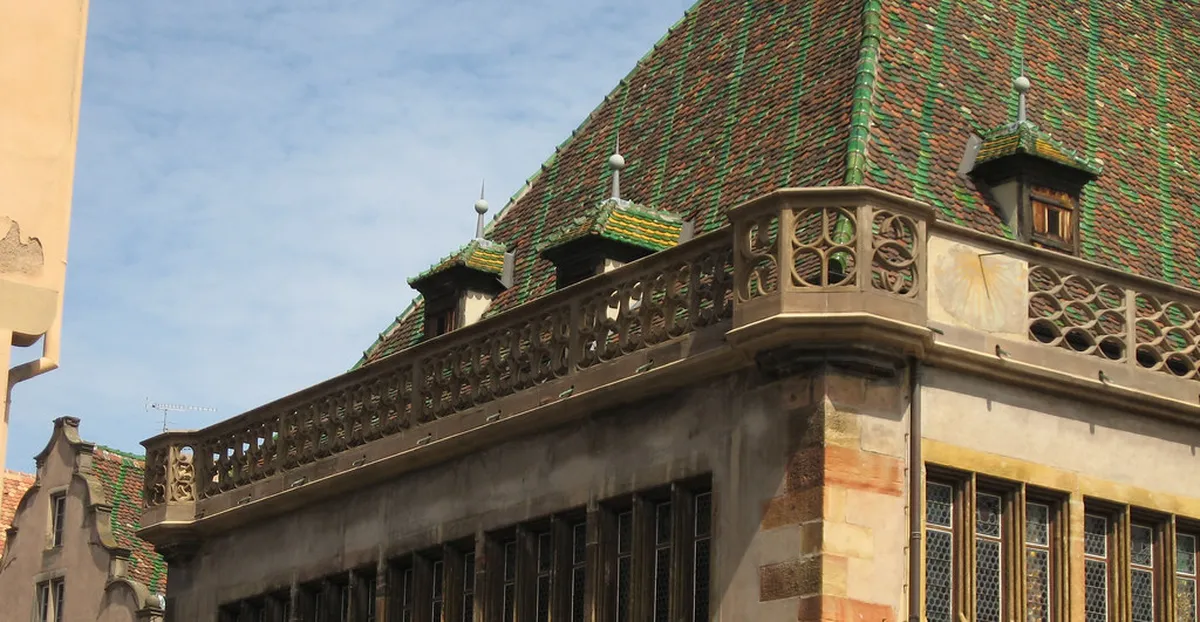
The Koïfhus is one of Colmar's finest examples of the transition from Gothic to Renaissance design. Its most famous feature is the steeply pitched roof covered in glazed, polychrome tiles — the green, red and yellow geometric pattern that catches the light above the rooftops of the old town. The roofline is crowned by an ornamental belfry and an elaborately carved stone balustrade, with a sundial marking one corner of the building.
Inside, the first floor holds the Grand'Stube, a grand vaulted hall that served in turn as a courtroom for the city tribunal, the meeting chamber of the Décapole council, and the seat of Colmar's municipal council. An external covered staircase and a small arcaded loggia link the building to the square below. The result is a compact but richly detailed civic monument that packs Colmar's medieval commerce, justice and self-government into a single roof.
The Square & Markets
Place de l'Ancienne Douane is the cobbled square that fans out from the foot of the Koïfhus, and it is one of the most photographed corners of Colmar. The square is completely free to access at any time; only the interior of the Koïfhus is occasionally closed off, opening for the temporary exhibitions, fairs and events it now hosts. A bronze statue of the Colmar-born statesman Lazarus von Schwendi, sculpted by the local artist Auguste Bartholdi, stands at the centre, surrounded by fountains and a ring of half-timbered Alsatian houses.
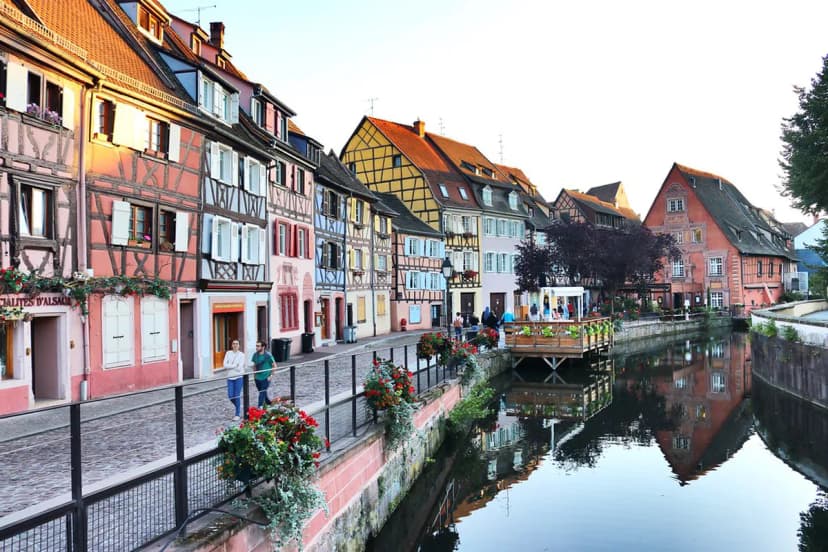
The square comes alive with seasonal markets. In summer, café terraces spill across the cobbles; in winter, Place de l'Ancienne Douane is one of the prettiest of Colmar's celebrated Christmas market sites, with wooden chalets clustered beneath the glazed roof. It also sits a short stroll from the canals of Little Venice — pair this stop with our Little Venice & Old Town guide for a full walking route through the historic centre.
Getting There
The Koïfhus sits at the heart of Colmar's pedestrian old town, where the Grand'Rue meets Place de l'Ancienne Douane, so the easiest way to reach it is on foot. From Gare de Colmar, the main railway station, it is roughly a 15-minute walk east into the historic centre, or a few minutes by local bus toward the town hall. The square is closed to general traffic; drivers should use one of the perimeter car parks, such as the Lacarre or Rapp underground garages, and continue on foot.
Because the entire old town is compact and flat, the Koïfhus pairs naturally with nearby sights such as the Unterlinden Museum, the canals of Little Venice and the lanes of the former tanners' quarter. For more under-the-radar corners around it, see our roundup of hidden gems in Colmar, and for another landmark a few steps away, visit the Renaissance Maison Pfister.
Frequently Asked Questions
Is the Koïfhus free to visit?
Place de l'Ancienne Douane, the square in front of the Koïfhus, is completely free and open at all times, so you can admire the building's glazed-tile roof and façade at no cost. The interior is not a permanent museum — it opens only for temporary exhibitions, fairs and events, which may charge admission depending on the programme.
How old is the Koïfhus and what was it used for?
The Koïfhus, or Ancienne Douane (Old Customs House), was completed in 1480 and is the oldest public building in Colmar. It served as a customs house and storehouse on the ground floor, while the first-floor Grand'Stube hall hosted the city tribunal, the council of the Décapole league of ten Alsatian imperial cities, and the municipal council.
What is the Décapole connection?
The Décapole was a federation of ten Alsatian imperial cities, active from 1354 to 1679, that allied for defence and shared interests. The Koïfhus was one of its meeting places, and the coats of arms of the Décapole cities still decorate the upper windows of the building.