7 Key Things to Know Before Visiting the Unterlinden Museum
Plan your visit to the Unterlinden Museum in Colmar. Discover the Isenheim Altarpiece, Herzog & de Meuron architecture, ticket prices, and expert tips.
On this page
7 Key Things to Know Before Visiting the Unterlinden Museum
The Unterlinden Museum stands as a beacon of culture in the heart of Colmar's historic center. This world-class institution combines ancient religious history with cutting-edge modern design in a unique architectural setting. Visitors often flock to this site to witness the world-renowned Isenheim Altarpiece in person. It remains one of the most essential 12 Best Things to Do in Colmar 2026: A Fairy Tale Guide for art lovers and history buffs.
You can easily spend several hours exploring the vast collections that span over seven thousand years of human history. The museum occupies a former 13th-century Dominican convent that once housed a community of religious women. Recent expansions have transformed the space into a massive complex that balances medieval charm with contemporary flair. Planning ahead will ensure you see the most significant masterpieces without feeling rushed through the galleries.
Free guide: France's Hidden Gems
12 under-the-radar places across Provence, Alsace & Occitanie — with the best season to visit each and a local tip you won't find in the guidebooks.
The History and Origins of the Unterlinden Museum
The story of the museum begins in the 13th century when the Dominican convent of Unterlinden was first established. For centuries, the site served as a center of spiritual life and religious devotion in the Alsace region, becoming a major hub of Christian mysticism in the Rhine Valley during the 14th and 15th centuries. The convent was suppressed during the French Revolution, after which the buildings passed to the city of Colmar and were repurposed as military barracks. By the mid-19th century the former convent was facing demolition, and local scholars mobilized to prevent its loss.
The turning point came in 1847 when Louis Hugot, archivist and librarian for the city of Colmar, founded the Schongauer Society to save the building and manage a growing collection of regional art and artifacts. A year later, a spectacular archaeological discovery accelerated the museum's birth: a Gallo-Roman mosaic unearthed in Bergheim was placed in the convent chapel. In 1852, works from the revolutionary museum were transferred to the former convent, and the museum opened its doors to the public in 1853. Its inaugural collection presented sculptures and painted panels salvaged from the Antonine commandery in Isenheim, setting the museum's identity as the primary guardian of Rhenish art.
Over the following decades the museum expanded its reach to include archaeological finds, decorative arts, and modern artistic movements. The integration of the municipal baths building in the 20th century marked another significant milestone in its physical growth. Today, the institution successfully bridges the gap between its monastic roots and its role as a modern cultural hub. It continues to evolve while maintaining a deep respect for the original stones of the Dominican convent.
Remarkable Architecture: From Gothic Cloister to Modern Extension
The architectural layout of the Unterlinden Museum is a fascinating dialogue between the medieval past and the modern present. At its core lies the original 13th-century Gothic cloister, which offers a serene space for quiet reflection. The pointed arches and delicate stonework provide a perfect backdrop for the museum's extensive collection of religious sculpture. This historic wing remains one of the most photographed 12 Best Things to Do in Colmar (2026): A Local Guide due to its preserved medieval atmosphere.
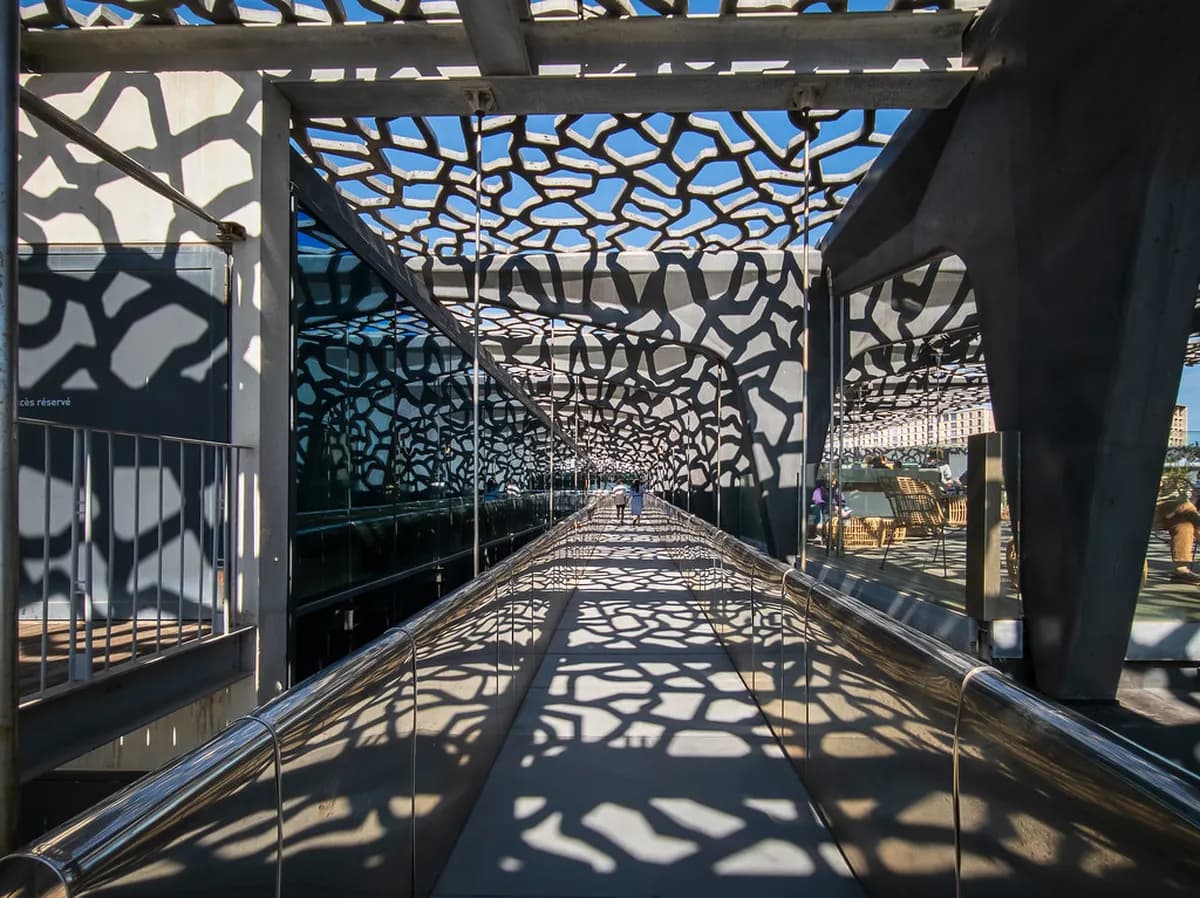
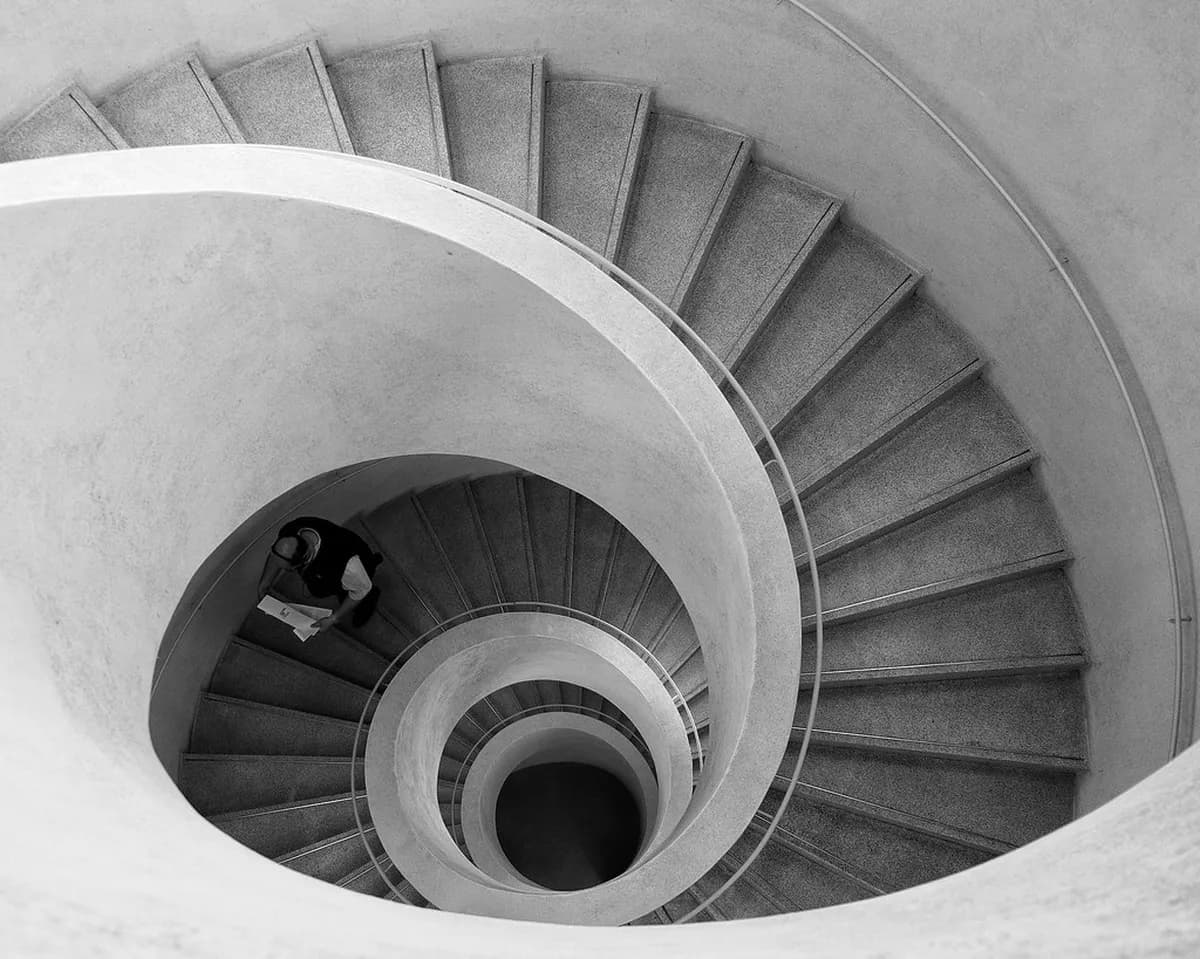
Between 2012 and 2015, the museum completed a major renovation and expansion project led by the Basel architects Herzog & de Meuron. This project added the Ackerhof building, which sits across from the original convent and houses the museum's modern and contemporary art galleries. The architects used traditional materials like brick and copper to ensure the new structures complemented the historic surroundings, a balance that earned widespread praise from the international press. The renovation also repurposed the adjacent Art Nouveau Municipal Baths, opened in 1906, which now serve as a venue for temporary exhibitions and events, their high ceilings and natural light creating an atmosphere entirely different from the intimate cloister.
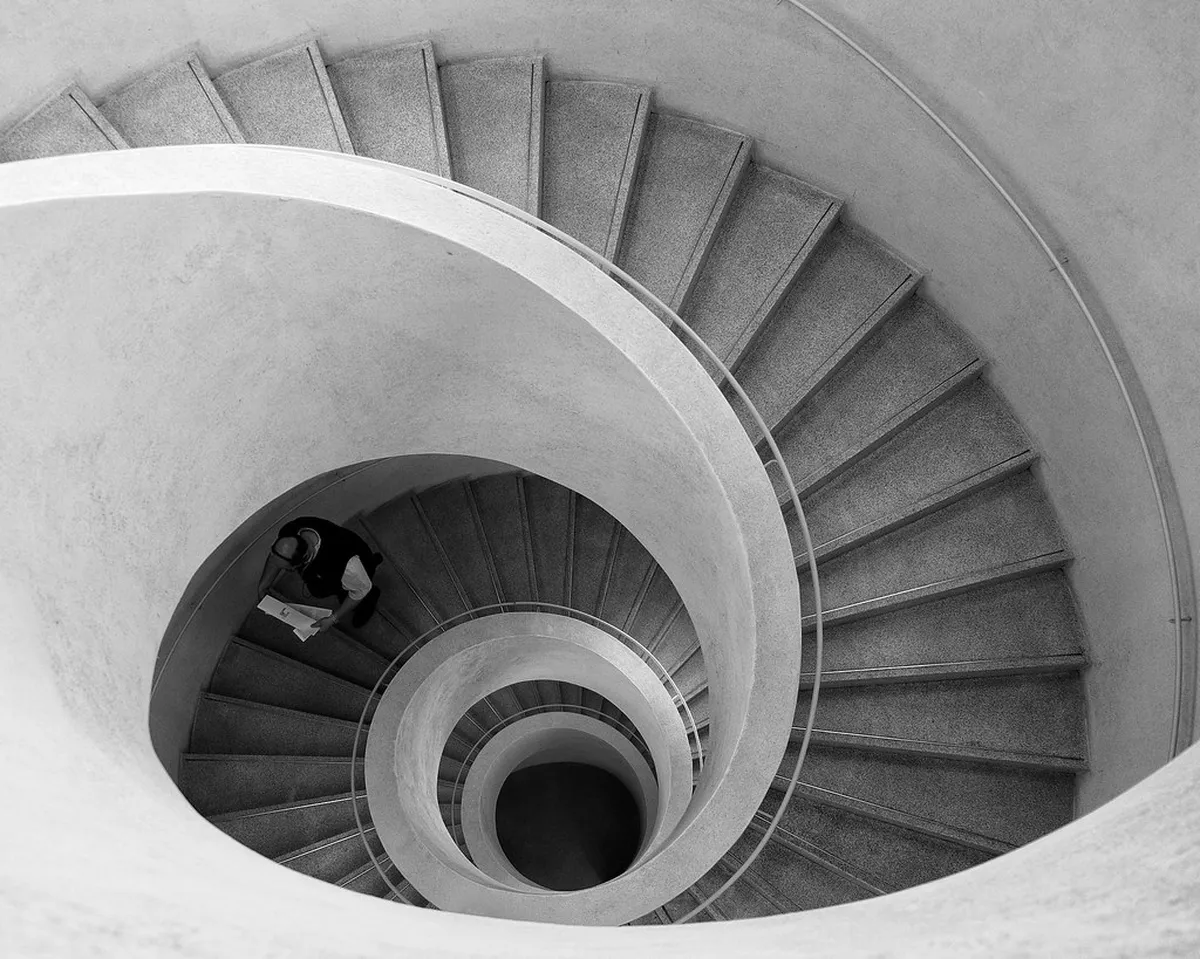
One of the most impressive and least-discussed features of the expansion is the underground gallery that runs beneath Place Unterlinden and the canal, connecting the convent to the Ackerhof extension via three dedicated exhibition rooms. This subterranean passage allows visitors to move seamlessly between buildings while encountering the history of the museum, 19th and 20th-century decorative arts, and rotating displays. The gallery is climate-controlled, which makes it ideal for sensitive works on paper and textiles. Architecturally, the contrast of descending into this modern passage from the Gothic chapel is one of the most memorable transitions in any French regional museum. The expansion more than doubled the exhibition space to nearly 8,000 square metres, making a single visit feel like touring several museums at once.
The Isenheim Altarpiece: A Masterpiece of Rhenish Art
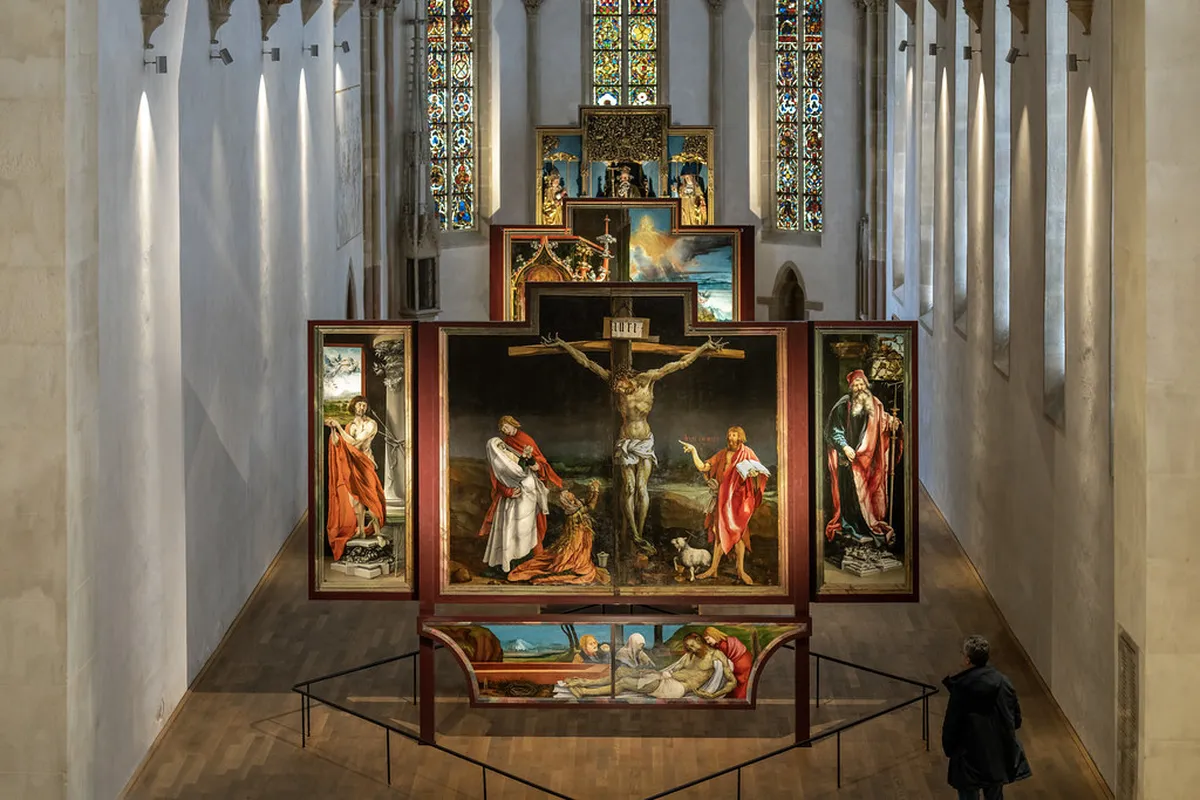
The Isenheim Altarpiece is widely considered the crown jewel of the Unterlinden Museum and a pinnacle of Western art. Created between 1512 and 1516, this monumental polyptych was originally designed for the monastery of St. Anthony in Isenheim, where it hung in the infirmary chapel. The altarpiece was intended to provide spiritual comfort to patients suffering from ergotism, a painful skin disease caused by a fungal infection of rye. Its vivid colors and intense emotional depth continue to move visitors centuries after its initial creation.
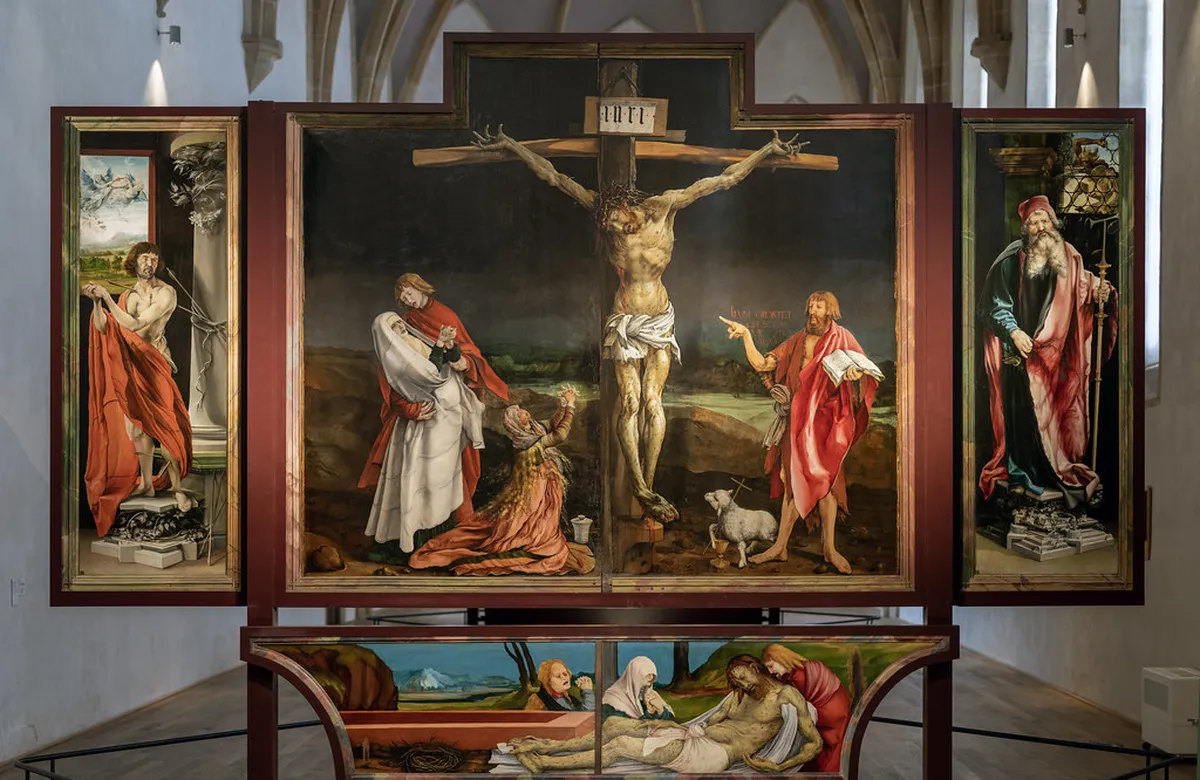
Matthias Grünewald painted the complex series of panels, while Nicolas of Haguenau sculpted the intricate gilded wood carvings around 1510. The work consists of multiple hinged layers that open to reveal different scenes from the life of Christ and Saint Anthony. The central depiction of the Crucifixion is particularly famous for its raw, unflinching portrayal of physical suffering — Christ's contorted fingers, the sickly pallor of his skin, and Mary Magdalene's anguish are rendered with an almost unbearable realism. In contrast, the inner panels radiate with brilliant light and joyful scenes of the Resurrection and the Nativity, the transition between panels serving as a visual metaphor for the passage from suffering to redemption.
Recent restoration efforts have brought back the original luminosity of the pigments used by Grünewald. The museum has carefully updated the lighting and display cases to ensure the altarpiece is viewed in optimal conditions. Visitors can now see fine details in the brushwork that were previously obscured by layers of old varnish. The work is displayed in the former chapel of the convent — take the time to walk around all sides of the structure to grasp the full narrative complexity that unfolds across its panels.
Navigating the Collections: From Prehistory to Contemporary Art
While the altarpiece is the main draw, the museum offers a rich variety of collections spanning seven millennia. The archaeological section features finds from the Neolithic period through the Merovingian era, including objects from domestic life and funerary contexts. The hidden gem of this section is the Bergheim Gallo-Roman mosaic, discovered in 1848 and one of the most significant Roman floor mosaics found in Alsace. Its intricate geometric patterns and figurative scenes are remarkably well-preserved and often overlooked by visitors rushing toward the altarpiece.
The medieval and Renaissance galleries in the Gothic cloister house an impressive array of paintings by Martin Schongauer, Hans Holbein the Elder, and Lucas Cranach, alongside collections of decorative arts, ceramics, and traditional Alsatian folk art. These works showcase the unique style of Rhenish art that flourished in the Upper Rhine valley during the late Middle Ages. The underground gallery then introduces 19th and early 20th-century art and the history of the museum's own formation — a section that puts the Schongauer Society's collecting mission into vivid context.
The modern and contemporary art collection in the Ackerhof building features works by Monet, Picasso, Otto Dix, Nicolas de Staël, Soulages, and Dubuffet. The spacious, light-filled galleries provide room to appreciate large-scale installations and abstract compositions. It is a deliberate change of register after the intensity of the medieval chapel. The former municipal baths swimming pool within the Ackerhof complex is now an event space with extraordinary architectural character — check whether any temporary exhibition is using it during your visit in 2026, as those shows tend to be the museum's most ambitious.
Practical Information: Opening Hours, Tickets, and Location
The Unterlinden Museum is located at Place Unterlinden, right at the entrance to the pedestrianized old town of Colmar. It is open Wednesday to Monday from 09:00 to 18:00 (last admission 17:30), and closed on Tuesdays. The museum also closes on January 1st, May 1st, November 1st, and December 25th. Always verify current hours on the official site at www.musee-unterlinden.com before your trip.
The table below compares the 2026 ticket options. Children under 12 enter free regardless of which ticket type you use.
- Adult: €14.00
- Reduced (students, seniors, groups): €11.00
- Youth (12–17): €8.00
- Children under 12: Free
- Pass Alsace (adult): Free entry included
- Pass Alsace (children): Free entry included
If Unterlinden is the only museum on your itinerary, a single-entry ticket is more cost-effective than the Pass Alsace. The pass becomes worthwhile once you are planning to visit three or more sites across the Alsace region — at that point the cumulative saving covers the pass cost comfortably. You can check the full list of Pass Alsace partner sites to calculate whether it suits your broader Colmar itinerary.
The Pass Alsace grants free entry to Unterlinden and 60+ regional attractions. Purchase it only if visiting three or more sites — Strasbourg Cathedral, wine villages, or other museums. Without the pass, Unterlinden's €14 ticket is better value for single-site visits.
Getting here without a car is straightforward. Bus lines 1, 3, 4, 5, 7, and 8 from Colmar station all stop at the Théâtre stop, a few steps from the museum entrance. On foot from the station the walk takes about 15 minutes through the historic center. Regional trains from Basel and Strasbourg run every 30 minutes and make Unterlinden a practical stop on a wider Alsace rail tour.
On-Site Services and Accessibility
The museum provides audio guides in multiple languages to enhance your understanding of the artworks. These guides offer deep insights into the Isenheim Altarpiece and the architecture of the convent. Expert-led guided tours are also available — check the daily schedule at the reception desk to see if any align with your visit time.
The entire complex is fully accessible for visitors with reduced mobility. Elevators and inclined planes connect the different levels of the convent, the underground gallery, and the new extension, so all rooms can be reached without stairs. Wheelchairs are available to borrow at the entrance. Guide dogs are welcomed throughout the museum. This level of accessibility is notably thorough compared to many historic French buildings, and it extends to prams as well, making Unterlinden one of the more family-friendly stops on a Colmar itinerary.
After your tour, the Schongauer café in the Ackerhof is a pleasant spot to sit with coffee or a light snack. A cloister garden and museum orchard are accessible from the historic wing — a quiet corner that most visitors walk past without noticing. The museum shop sells high-quality art books, prints, and Alsatian souvenirs, and is open without a gallery ticket if you simply want to browse.
Many Alsatian museums offer free admission on the first Sunday of each month. Check the official calendar in advance — Unterlinden participates in this regional program, making it an excellent time to visit without paying the standard €14 adult fee.
Colmar Museum Circuit: Pairing Unterlinden with Other Museums
Colmar has more museums per square kilometre than most comparable French towns, and Unterlinden is the obvious anchor, but the others repay a look depending on your interests. The Bartholdi Museum, on Rue des Marchands, is the birthplace of Frédéric Auguste Bartholdi, sculptor of the Statue of Liberty. Its rooms trace his working process from Alsatian fountains to the New York commission, and the scale models of Liberty in various stages of construction are genuinely surprising. Admission is around €5 and the visit takes about 45 minutes. It pairs naturally with Unterlinden for a full cultural morning without fatigue. The nearby Bartholdi connection in Colmar is covered in more depth in a dedicated guide.
| Museum | Price | Highlight |
|---|---|---|
| Unterlinden | €14 (adult) | Isenheim Altarpiece, 7,000 years of history, Herzog & de Meuron architecture |
| Bartholdi Museum | €5 | Statue of Liberty models and Frédéric Auguste Bartholdi's working sketches |
| Hansi Museum | €4 | Whimsical Alsatian village illustrations by Jean-Jacques Waltz |
| Musée du Jouet (Toy Museum) | €5 | 4,000+ toys and mechanical automata from the 19th century onward |
| Choco-Story Colmar | €9 (adult) | Interactive chocolate-making workshops and tasting experiences |
The Hansi Museum on Rue des Têtes celebrates the illustrator Jean-Jacques Waltz, whose whimsical depictions of Alsatian village life made him a cultural icon during the Franco-German conflicts of the early 20th century. It is a smaller, quieter space than Unterlinden and works well as a 30-minute detour. The Musée du Jouet (Toy Museum) on Rue Vauban houses over 4,000 toys and automata dating from the 19th century onward — it is aimed at families with younger children but the mechanical automata section appeals to adults too. Choco-Story Colmar, the chocolate museum near the train station, runs interactive workshops and suits visitors with children aged 6 and up.
For a rainy day in Colmar, the practical order is Unterlinden first (two to three hours), lunch in the Ackerhof café or along Rue des Marchands, then Bartholdi Museum for 45 minutes, and the Hansi Museum or Toy Museum to finish the afternoon. That sequence covers about six hours and keeps you almost entirely indoors. All four museums are within a ten-minute walk of one another, so the circuit requires no transport between stops.
Expert Tips for Planning Your Visit
To avoid the heaviest crowds around the Isenheim Altarpiece, visit on a weekday and aim to reach the chapel by 09:30, before the first tour groups arrive. If you find the space crowded on arrival, head directly to the modern art wing in the Ackerhof first and return to the altarpiece around 11:30, when groups have typically moved on to other sections. This reversal of the standard route makes the chapel encounter significantly more intimate.
Allow at least two to three hours to see the main highlights without rushing. The distance between the different wings surprises many visitors — the underground gallery alone is several hundred metres. Wear comfortable, flat shoes since the historic wing has uneven stone flooring. Many visitors find that a mid-morning arrival on a Wednesday or Thursday provides the best balance of energy and manageable crowd levels in 2026.
Photography is generally permitted for personal use throughout the permanent collection, but flash must be turned off to protect the delicate paintings. Some temporary exhibitions impose stricter rules, so look for signage in each gallery. Tripods are not allowed without prior authorization from museum management. Booking tickets online in advance is advisable during peak summer months (July and August) and around the Christmas market season in late November and December, when Colmar's visitor numbers spike considerably.
For quick facts, see our dedicated Musée Unterlinden and Musée Bartholdi attraction pages.
Frequently Asked Questions
What is the most famous work in the Unterlinden Museum?
The Isenheim Altarpiece is the most famous work in the museum. Created by Matthias Grünewald and Nicolas of Haguenau, it is a masterpiece of Rhenish art. This monumental work attracts thousands of visitors annually who come to see its vivid panels and intricate carvings.
How much time do you need to visit the Unterlinden Museum?
You should plan for at least two to three hours for a standard visit. This allows enough time to see the Isenheim Altarpiece and explore the modern art extension. If you are an art enthusiast, you may want to stay longer to see the archaeological collections.
Is the Unterlinden Museum included in the Pass Alsace?
Yes, the Unterlinden Museum is fully included in the Pass Alsace. This can be a great way to save money if you plan to visit other sites. Check the best time to visit Colmar to maximize your pass usage across the region.
What are the opening hours for the Unterlinden Museum?
The museum is typically open from 9:00 AM to 6:00 PM daily, except for Tuesdays when it is closed. It also closes on certain public holidays like January 1st and May 1st. Always verify the current hours on the official museum website before your arrival.
The Unterlinden Museum is a world-class destination that offers a profound journey through art and history. From its medieval convent roots to the striking modern extension, the site is an architectural marvel in its own right. Witnessing the Isenheim Altarpiece in person is an unforgettable experience for any traveler visiting the Alsace region. Make sure to include this cultural treasure on your list of must-see sites during your next trip to Colmar.
Free guide: France's Hidden Gems
12 under-the-radar places across Provence, Alsace & Occitanie — with the best season to visit each and a local tip you won't find in the guidebooks.
You might also like


Continue reading
More guides you'll find useful