Getting Around Montpellier Travel Guide
Plan getting around montpellier with top picks, neighborhood context, timing tips, and practical booking advice for a smoother trip.
On this page
Getting Around Montpellier
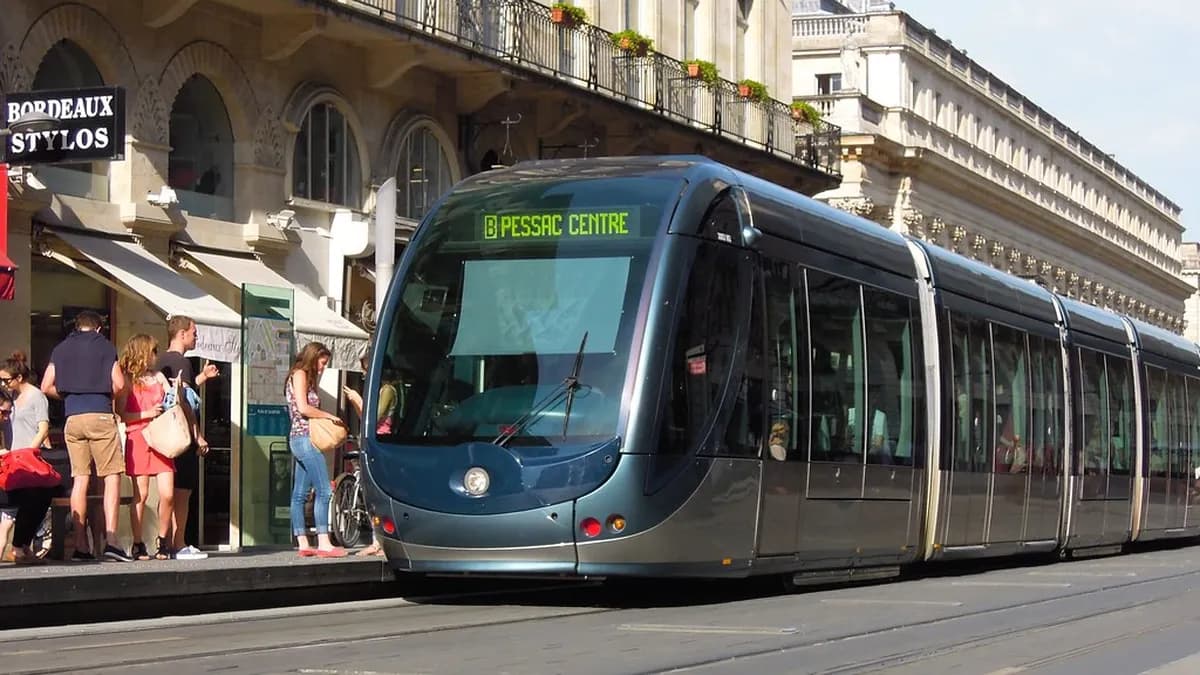
Montpellier is one of the easiest French cities to navigate without a car. Four colour-coded tram lines run by TaM (Transports en commun de l'agglomération de Montpellier) connect the train station to the beach, the historic centre, and the modern Antigone district. Most visitors can cover the city's highlights using trams and their own feet. This guide gives you the practical details — ticket prices, passes, Vélomagg bikes, and the rules around the city's free-transit policy — so you waste no time on arrival.
One thing to understand immediately: Montpellier made headlines in 2023 by extending free public transport to all residents of the métropole. That policy does not apply to tourists. Visitors are still required to carry a valid paid ticket on every bus and tram. Knowing this before you queue at the vending machine saves a lot of confusion.
The Four Tram Lines (TaM)
TaM operates four tram lines that form the backbone of the city's transit network. Line 1 (blue) runs east–west from Mosson to Odysseum and is the busiest route, passing through the central hub at Gare Saint-Roch. Line 2 (orange) runs north–south from Jacou to Saint-Jean-de-Védas, also calling at Gare Saint-Roch. Line 3 (green) links Juvignac to Pérols-Étang de l'Or via the Comédie, and Line 4 (gold) follows a shorter circular route through the historic centre including the Peyrou-Arc de Triomphe stop.
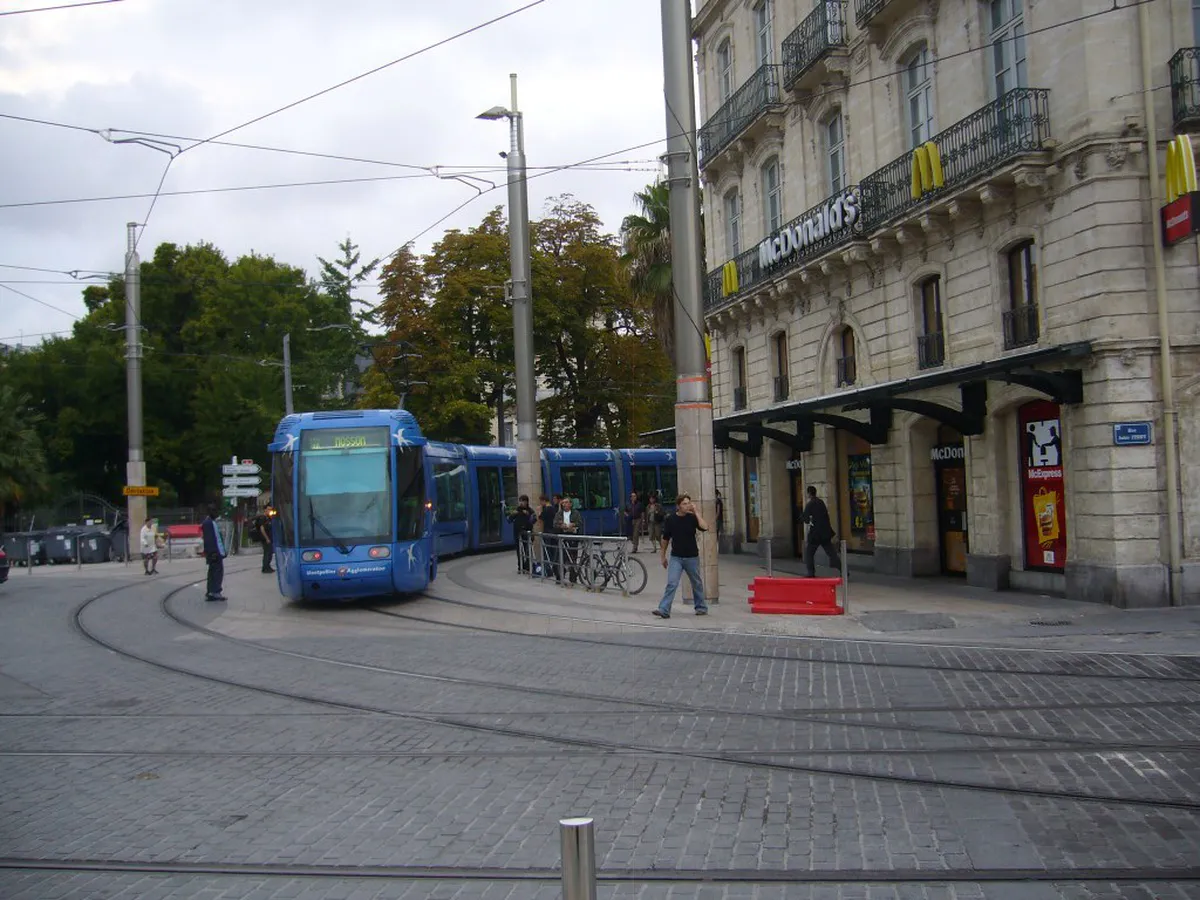
For most tourists, Lines 1 and 4 are the most useful. Line 1 connects the main train station to the commercial areas at Odysseum. Line 4 loops around the medieval Écusson district and drops you within a two-minute walk of the Arc de Triomphe and the Promenade du Peyrou. Trams on Line 1 run every three to five minutes during the day; Line 4 runs roughly every eight minutes. All four lines serve the Comédie stop, which makes it the easiest interchange point in the city.
Trams run from roughly 05:00 to 01:00 on weekdays and until around 02:00 on Friday and Saturday nights. Night buses cover the gaps, but trams are the more comfortable option for late evening journeys back from Montpellier's bars and clubs. Check the TaM website or the M'Ticket app for the exact last-service times on any given day, as schedules vary on public holidays.
Always validate your ticket immediately upon boarding using the orange validators near the tram door. An unvalidated ticket is treated the same as no ticket during an inspection, and on-the-spot fines for tourists without a valid ticket can reach €80 or more.
Tickets, Passes, and Prices
A single trip (1V) is valid for 1 hour 30 minutes from validation and allows unlimited transfers between trams and buses within that window. For visitors making more than three or four journeys a day, a 24-hour pass is almost always better value. A family/group pass covers up to five people travelling together for 24 hours. A ten-trip carnet (10V) is a solid option if you are staying for several days and want to avoid buying individual tickets each time.
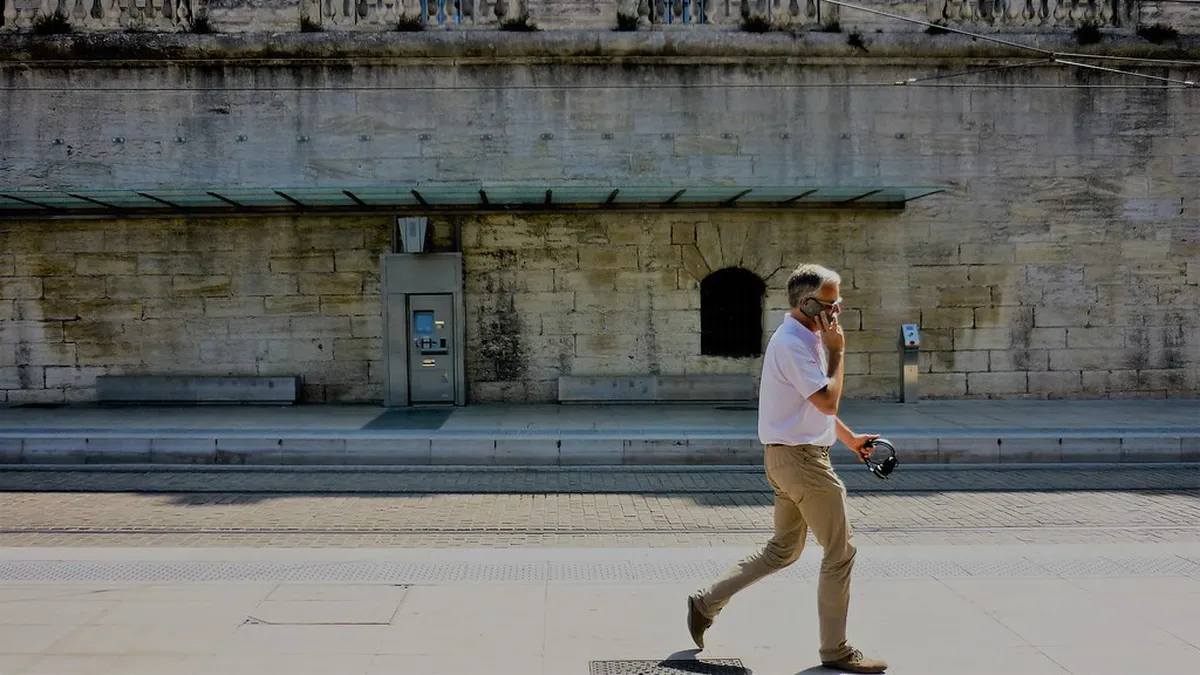
You can buy tickets in four ways. The M'Ticket TaM app (iOS and Android) lets you purchase 1V, 10V, 24h, and family passes in advance and activate them when you board — no paper required. The online TaM shop sells time-stamped QR codes you scan at the station. Sixty-four ticket vending machines remain in operation at major stops including Comédie, Corum, and Gare Saint-Roch — these accept card and coins and print a paper ticket valid immediately. Finally, around 80 relay-merchants (tabac shops, newsagents, and small convenience stores throughout the city) sell time-stamped paper tickets — useful if you run out of battery or are far from a machine.
Fares were not changed when free transit for residents was introduced, so prices remain the same as before 2023. Always validate your ticket immediately upon boarding using the orange validators near each tram door. A valid but unvalidated ticket is treated the same as no ticket during an inspection — and on-the-spot fines for tourists can reach €80 or more. Keep your validated ticket or pass accessible until you leave the vehicle.
- 1V (single trip, 1h30 validity) — standard fare, available at machines, app, relay-merchants
- 10V carnet — cheapest per-trip option for multi-day visitors
- 24h pass — best value if you make four or more trips in a day
- Family/group pass (24h, up to 5 people) — good for families visiting Montpellier with kids
| Ticket Type | Validity | Coverage | Best For |
|---|---|---|---|
| 1V (Single Trip) | 1 hour 30 minutes | Unlimited transfers between trams and buses | One-off journeys |
| 10V Carnet | Each trip valid 1h30 from use | Unlimited transfers per trip | Multi-day stays with 2–3 trips daily |
| 24-Hour Pass | 24 hours from first activation | Unlimited tram and bus rides | Four or more trips in a single day |
| Family/Group Pass (24h) | 24 hours from first activation | Up to 5 people, unlimited rides | Groups and families traveling together |
As a visitor to Montpellier, you will not qualify for the Free Pass even though residents travel free. You must have a valid paying ticket on every journey — the policy does not apply to tourists, and controllers actively check passengers on the network.
The Free Pass — and What It Means for Visitors
Since the introduction of the Pass gratuité, all residents of the Montpellier Métropole can ride buses and trams at no cost. To qualify, a resident must be registered at an address within the métropole and apply in person or through the M'Ticket app with an ID, a passport photo, and a proof of address. Children aged 3 to 17 also need parental authorisation. The pass is issued as a physical TaM card or a QR code in the app.
As a visitor, you will not qualify for the Free Pass. You need a paying ticket on every journey, full stop. The official montpellier.fr website is explicit: "To travel in good standing on the transport network's buses and streetcars, all non-resident passengers or residents who do not have the Pass gratuité must be in possession of a valid paying ticket." Do not board without one — controllers are active on the network and will ask to see your ID if you cannot show a valid ticket or QR code.
One practical point the free-transit debate often overshadows: even Free Pass holders must have their TaM card or QR code ready during an inspection. If their phone battery dies, the controller records their ID and they receive a follow-up notice. The lesson for tourists is the same — keeping your phone charged or carrying a physical carnet ticket avoids any awkward moment at the validator.
P+Tram Park-and-Ride: A Useful Hack for Day-Trippers
Since December 2023, residents with a Free Pass can park free for 24 hours at any of the nine P+Tram (park-and-ride) stations, provided they declare the journey in the M'Ticket app to confirm they used the tram. For non-residents and visitors, P+Tram car parks remain accessible at a fee via the regular monthly or annual pass. You can also buy a P+Tram pass at the automatic ticket machines on site.
This matters if you are staying outside Montpellier and driving in for the day. Parking at a P+Tram station on the edge of the city and taking a tram into the centre is significantly cheaper and faster than hunting for a central parking spot during the day. The Odysseum P+Tram on the east end of Line 1 and the Mosson P+Tram on the west end are the largest and usually have space on weekday mornings. From either, you are roughly 20 minutes from the Place de la Comédie.
This park-and-ride option does not appear in most tourist guides for Montpellier, but it is genuinely useful for anyone doing a day trip from the Hérault countryside or the coast. Combine it with a 24h tram pass purchased at the machine when you arrive and you have a low-cost, car-free day in the city.
Walking the Écusson: The Historic Centre on Foot
The Écusson — Montpellier's medieval walled centre — is almost entirely pedestrianised. Trams do not run through it; they ring its edges. Once you step off at Comédie, Corum, or Peyrou-Arc de Triomphe, you navigate the Écusson on foot. The network of narrow streets connecting the Place de la Comédie to the Jardin des Plantes and the Arc de Triomphe takes about 15 minutes to cross end-to-end at a relaxed pace.
The major 12 Best Montpellier Attractions and Places to Stay in this area — the Musée Fabre, the Pavillon Populaire, the Place de la Canourgue, and the medieval hôtels particuliers along Rue de l'Ancien Courrier — are all within a few hundred metres of each other. There is no efficient tram route between them because the streets are simply too narrow for vehicles. Walking is not just the budget option here; it is the only sensible option.
For longer journeys outward from the centre — to Antigone, the Lez riverfront, or the botanical garden — trams save meaningful time. Line 1 eastward from Comédie reaches the modern Antigone district in one stop and the shopping at Odysseum in about 20 minutes. Line 4 westward from Comédie reaches the Peyrou esplanade area in two stops. Keep your validated pass for these cross-city hops and walk everything in between.
Vélomagg Bikes and Cycling Routes
TaM operates the Vélomagg bike-share scheme with automated docking stations spread across the city and the wider métropole. You can rent a standard bike or an electric-assist model. Registration and rental are managed through the Vélomagg app or at the terminal on any docking station. Short trips under 30 minutes on a standard bike cost very little; longer hires are charged by the hour.
The most useful cycling route for visitors is the path along the Lez River, which runs south from the city centre toward the sea. It is mostly flat, largely separated from car traffic, and connects Antigone to the Parc de Méric and points further south. On a calm morning this is a far more pleasant way to reach the outer parks than waiting for a bus. The Promenade du Peyrou and the Parc Montcalm area are also comfortably reachable by bike from a station near the Comédie.
Note that bikes cannot be taken onto trams, so Vélomagg and the tram network are alternative options rather than combinations. If you are cycling back from a longer route and run out of energy, just return the bike to any docking station and pick up a tram from the nearest stop. The docking network is dense enough in the centre that you are rarely more than five minutes from a station.
Do You Need a Car in Montpellier?
For a standard city visit, no. The tram network reaches Gare Saint-Roch (trains to Paris, Barcelona, and the rest of France), the airport bus terminus, the beach tramway connection at Pérols, and all major tourist sites. The Montpellier airport is served by a shuttle bus (Line 120) that connects to the tram network. You do not need a car to move between the airport, your hotel, and the city's highlights.
A car becomes useful only for day trips to villages in the Hérault countryside or for a day trip to La Grande Motte or Palavas, which are not well-served by public transport. If that is on your itinerary, hiring a car for a single day is more practical than keeping one for your whole stay. Parking in the city centre is expensive and the one-way streets in the Écusson are genuinely confusing.
The city's commitment to reducing car traffic means driving is deliberately discouraged in the centre. Several streets are bus-and-bike only. The result is that the tram moves faster through central Montpellier than a car in most conditions. For visitors staying in a central hotel, a transport pass and a pair of comfortable shoes will cover almost everything on a typical itinerary.
Planning Your Trips: The TaM App and Peak Hours
The M'Ticket TaM app is the single most useful tool for navigating the network. It shows live departures, route maps, and lets you buy and activate tickets without hunting for a vending machine. Download it before you arrive; it works on both iOS and Android and the interface is available in French and English. For a detailed history of how the tramway system developed, Wikipedia has comprehensive coverage. You can purchase tickets in advance and activate each one at the moment you board, which avoids any queue at the machine during busy periods.

Public transport in Montpellier is genuinely saturated during the morning commute (08:00–09:30) and the late afternoon return (17:00–18:30). Line 1 in particular is very crowded between Gare Saint-Roch and Comédie on weekday mornings. If you are sightseeing rather than commuting, plan your first journey for 10:00 or later and avoid heading back toward the station on a Friday evening. During major university events and the summer festivals, all four lines see above-average loadings — allow extra time and consider walking short stretches rather than waiting on a packed platform.
The TaM social media accounts also post real-time alerts for service disruptions, track maintenance, and event-day service changes. This is worth checking on mornings when you have a train connection to catch. A tram delay that costs you 15 minutes on a normal sightseeing day costs you a missed connection if you have not built in buffer time.
Frequently Asked Questions
Which getting around montpellier options fit first-time visitors?
First-time visitors should rely on the four colourful tram lines and walking. The trams connect all major landmarks, while the historic centre is best explored on foot. You can find more details in our Montpellier Travel Guide: The Ultimate South of France Guide. This combination is the most efficient way to see the city.
How much time should you plan for getting around montpellier?
Most central attractions are within 15-20 minutes of each other by tram or walking. You should allow extra time during the morning and evening rush hours when trams are crowded. Planning 30 minutes for any cross-city journey is usually sufficient for a stress-free day of sightseeing.
What should travelers avoid when planning getting around montpellier?
Avoid traveling during peak rush hours between 8:00 AM and 9:30 AM to escape heavy crowds. You should also never board a tram without a validated ticket, as fines are very high for tourists. Do not assume that the free transport policy for residents applies to international visitors.
Is getting around montpellier worth including on a short itinerary?
Yes, the efficient tram system makes it very easy to see the main highlights in a single day. You can quickly move from the historic centre to the modern Antigone district or the gardens. The ease of transport allows you to maximise your time even on a very tight schedule.
Getting around Montpellier is straightforward once you understand two things: the tram network covers almost everything a visitor needs, and the city's free-transit policy applies only to registered residents. Buy and validate your ticket before boarding, use the M'Ticket app for real-time planning, and save your energy for exploring the Écusson's medieval lanes on foot. The result is a city that genuinely rewards visitors who leave their car behind.
Whether you are heading to a world-class museum, a botanical garden, or a day on the coast, the local network has you covered. Keep this guide handy as you navigate the tram stops and sun-filled plazas of this Mediterranean city.
You might also like



Continue reading
More guides you'll find useful