Notre Dame de la Garde: The Complete Marseille Visitor Guide
Discover Notre Dame de la Garde in Marseille: free entry, golden mosaics, panoramic harbor views, and practical visitor tips for this iconic basilica.
On this page
Notre Dame de la Garde: Marseille's Iconic Golden Basilica
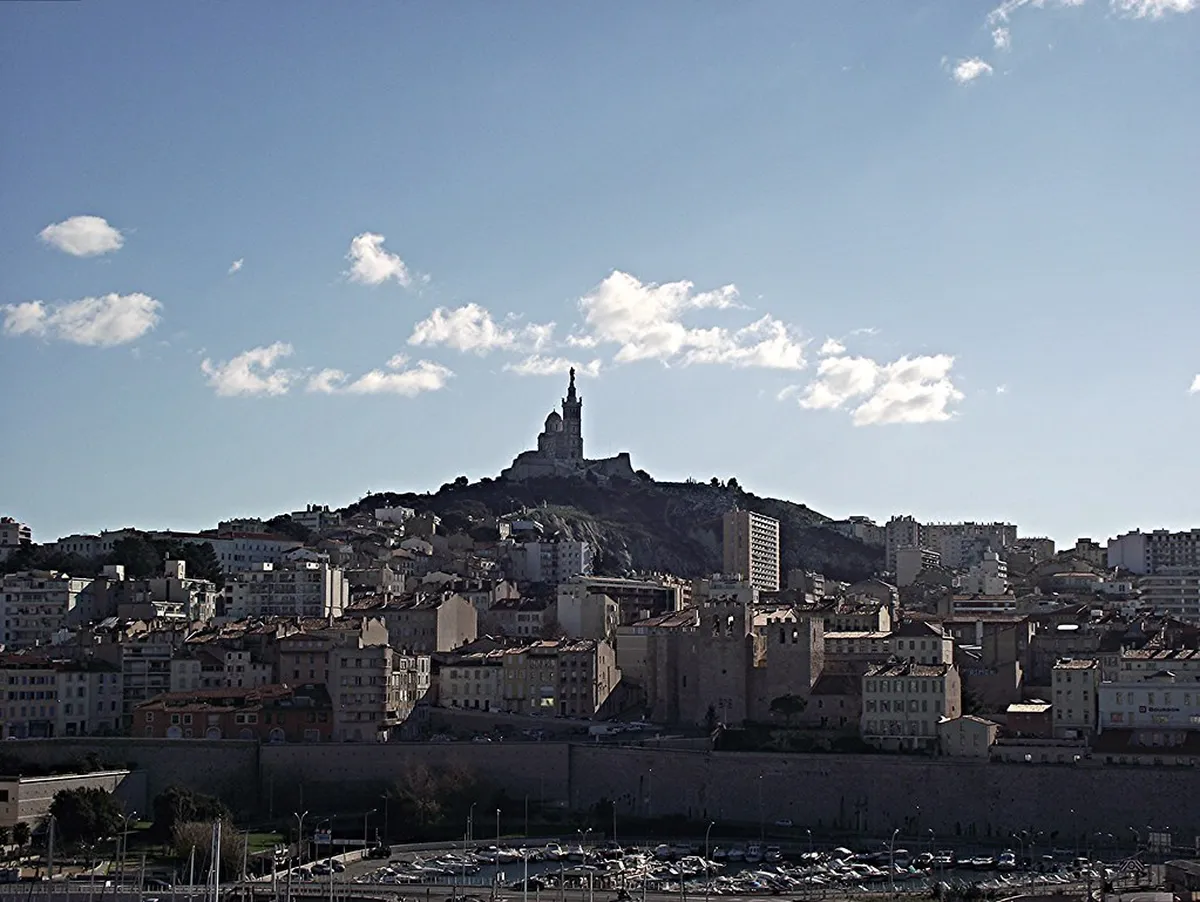
High above the Phocaean city stands the majestic silhouette of Notre Dame de la Garde. This stunning basilica serves as the spiritual heart and most famous landmark of Marseille. Locals affectionately call it 'La Bonne Mère' because they believe it protects the city and its sailors.
Visitors flock to this limestone peak for its incredible architecture and even better views. You can see the entire coastline and the shimmering Mediterranean Sea from the terrace. This guide covers the history, art, ex-voto tradition, and the logistics of visiting this sacred site in 2026.
Whether you are a history buff or just looking for the perfect photo, this spot never fails to impress. We will cover everything from the golden mosaics to the best way to climb the hill. Prepare to discover why this is one of the most essential 18 Best Marseille Attractions & Travel Tips for any traveler.
The History and Origins of the "Bonne Mère"
The story of Notre Dame de la Garde spans more than 800 years of continuous pilgrimage. A small chapel dedicated to the Virgin Mary stood on this hill as early as 1214, founded by Master Pierre, a local hermit priest who envisioned a sanctuary for sailors and fishermen. This modest structure established the hill as a place of refuge and prayer for anyone departing or returning by sea. Learn more about the full documented history on Wikipedia.
The chapel was rebuilt in the 15th century, then destroyed in 1853 to make way for a much larger basilica. The driving reason was cholera. Pilgrims were arriving in ever-greater numbers, and the site needed room to hold them. Architect Henri-Jacques Espérandieu designed the new structure in a grand Neo-Byzantine style, and construction took over forty years to complete.
Over the centuries the deep connection between the hilltop church and Marseille's seafaring population created the nickname 'La Bonne Mère' — the Good Mother. Sailors would look up at the hill as they entered the Old Port to give thanks for a safe voyage. That tradition continues today. Pilgrims still visit to fulfill vows or ask for blessings, and the walls are lined with tokens of gratitude that stretch back generations.
Admission to Notre Dame de la Garde is completely free. The basilica is open daily from 07:00–19:00 (summer) and 07:00–18:00 (winter). This makes it one of the most affordable attractions in Marseille, perfect for budget travelers.
Architectural Splendor: Neo-Byzantine Mosaics and Design
The architecture of Notre Dame de la Garde is a masterpiece of the Neo-Byzantine style that was fashionable in France during the mid-1800s for its exotic grandeur. The exterior uses alternating bands of red and white stone — a pattern that creates a vibrant, almost theatrical look against the blue Provençal sky. White marble from Carrara and red marble from Brignoles run throughout the interior surfaces.
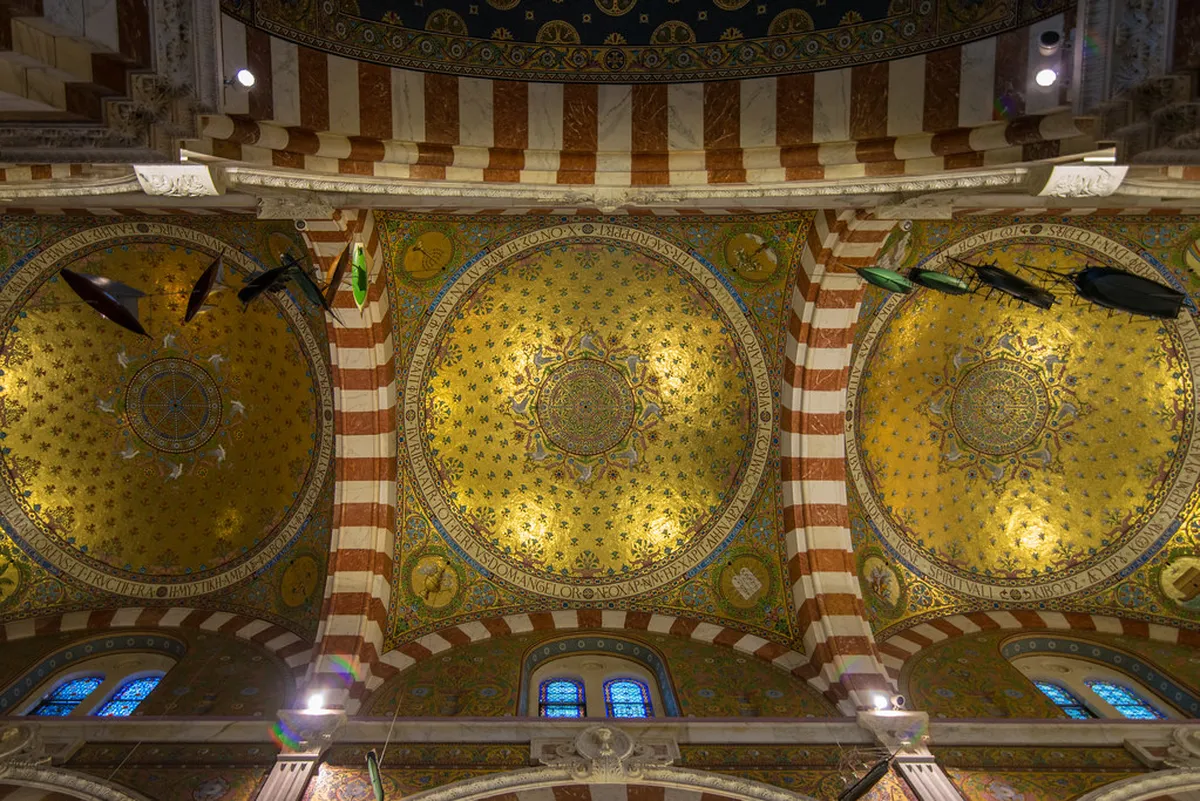
Inside, the basilica is a riot of color and light thanks to its extensive gold mosaics. These intricate artworks cover the domes and walls with biblical scenes. Light reflects off gold surfaces to create a warm glow throughout the day. The total mosaic surface covers roughly 1,200 square meters, laid in millions of individual tesserae pieces. Discover detailed information about the official basilica site for current services and updates.
One of the most striking features is the contrast between the upper church and the crypt directly below it. The upper church is bright and opulent — this is the glory-of-heaven register. In contrast, the crypt was carved directly into the rock and feels somber and elemental. Its simple Romanesque lines have no paintings or ornaments; the effect is deliberately austere. Walking between the two levels within a single visit gives a sense of the full range of Catholic sacred architecture compressed into one site.
Architect Espérandieu successfully blended military strength with religious beauty. The building sits inside the walls of an old fort, which influenced its sturdy and defensive appearance. You can still see the original drawbridge and bastions near the entrance. This makes the basilica one of the most rewarding stops for architecture lovers among all 15 Best Things to Do in Marseille.
The Basilica in Figures: Height, Weight, and Gold
The technical dimensions of the basilica match its visual impact. The entire structure sits at an altitude of 149 to 157 meters above sea level depending on where you measure, making it visible from almost every corner of the city. The hill functions as a constant compass for locals navigating the winding streets below. The bell tower adds a further 41 meters, its great bell — named Jeanne-Marie and weighing 8,234 kilograms — audible across the port on calm days.
At the very top of the tower stands the famous copper statue of the Virgin and Child, sculpted by Eugène Lequesne and cast by the Christofle company. The figure is 11.2 meters tall and weighs nearly 9,796 kilograms. It is covered in gold leaf, which makes it sparkle brilliantly under the Mediterranean sun and gives the basilica its recognizable golden crown visible from the water.
Maintaining that golden glow is a significant technical undertaking. The statue requires regilding every 25 years to protect it from the salty sea air. Workers apply approximately 500 grams of gold leaf during each regilding operation. The interior nave runs 32.7 meters long and 14 meters wide, lined with side chapels each measuring roughly 3.8 by 5.4 meters.
- Golden statue: 11.2 m tall, 9,796 kg, gilded copper; regilded with 500 g of gold every 25 years
- Bell tower: 41 m high; bell Jeanne-Marie weighs 8,234 kg
- Mosaic surface: approximately 1,200 m² in gold and blue tesserae
- Nave dimensions: 32.7 m long, 14 m wide, with side chapels 3.8 m × 5.4 m
A Strategic Military and Religious Landmark
The hill of La Garde served a military purpose long before any church stood on it. In 1516, King Francis I came to Marseille and identified a critical weakness: the city had no means of protection against maritime attack from the south. He ordered the construction of a fort on Guard Hill and simultaneously commissioned a second fort on the island of If — the fortress that would later become the Château d'If, famous from Alexandre Dumas's novel. Even today you can spot the coat of arms of Francis I — the salamander — carved into the original stonework near the entrance. The fort has since been repurposed as the gift shop, parking area, and sacristy.
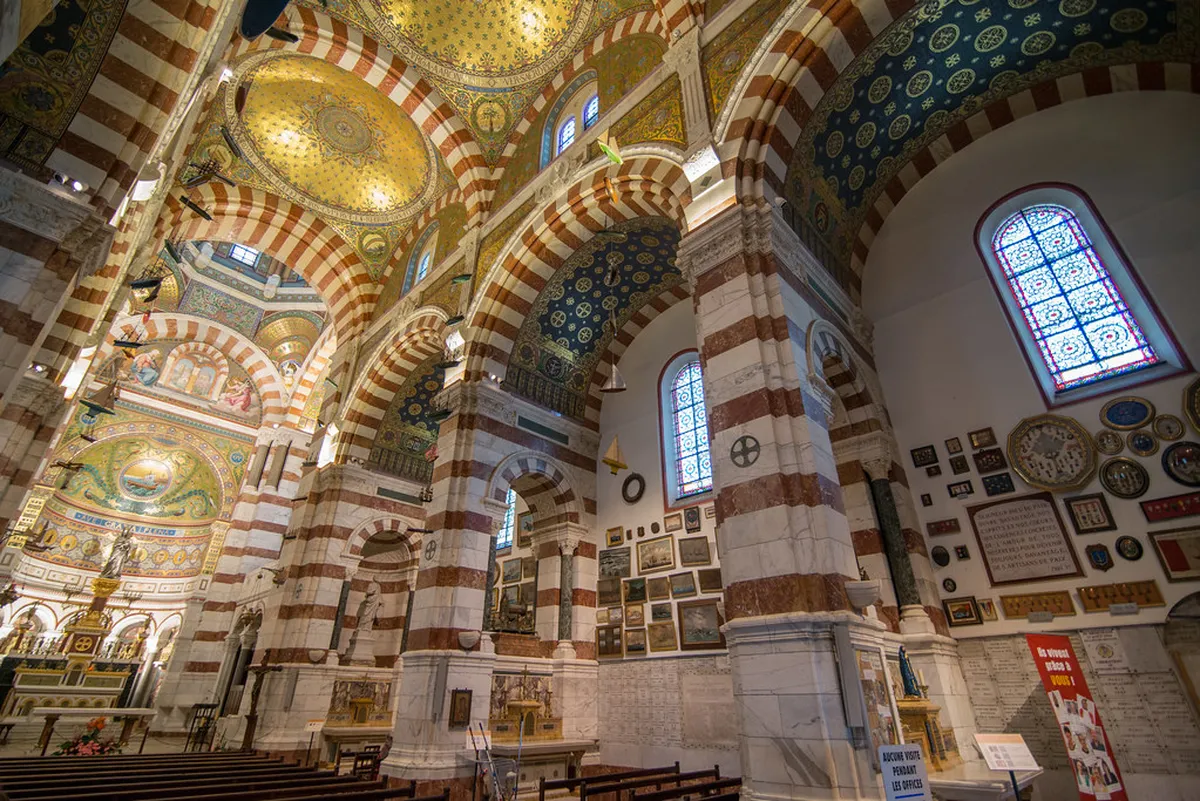
The current basilica was built inside the walls of this 16th-century fortress, which is why the building retains such a robust, defensive silhouette. That dual identity — simultaneously a place of prayer and a watchtower — runs through every corner of the site. It is a rare example of a church that has genuinely functioned both as a spiritual refuge and a military emplacement.
The religious and military histories converge most vividly in the ex-voto collection displayed throughout the nave and side chapels. These offerings — left by people fulfilling a vow or expressing gratitude — range from model ships and painted maritime disaster panels to crutches and prosthetics from people who credit miraculous healing to 'La Bonne Mère.' Dozens of painted scenes depict shipwrecks, fires, and battlefield escapes. Reading these panels, many of them hand-lettered with dates and names, turns the interior into an informal folk museum of Marseille's seafaring and military past. The oldest ex-votos date back to the 17th century.
The Onsite Museum and Restoration History
Since 18 June 2013, Notre Dame de la Garde has housed its own permanent museum. The space traces the full history of the site from its origins as a 13th-century chapel through to the construction of the current basilica and beyond. Admission is included with entry to the basilica — meaning it is free. For visitors interested in the deeper story behind the mosaics and ex-votos, the museum provides useful context that the sanctuary itself cannot convey.
The building has also undergone substantial restoration work. In 2001, architect Xavier David launched a seven-year programme to address deterioration caused by pollution and age. On the exterior, the Golfalina — the green stone used for the basilica's cladding — had been damaged and required replacement with more pollution-resistant stone. Inside, the mosaics had faded and cracked in places; their restoration was entrusted to Michel Patrizio, a mosaicist from Marseille who spent years re-laying individual tesserae by hand.
One detail that surprises many visitors is a historical curiosity now lost: for several decades, the public could climb a staircase inside the hollow Virgin Mary statue and look out through the statue's own eyes over the city. That access has long since been closed on safety grounds, but it is a reminder of how the relationship between Marseille and its 'Bonne Mère' has always been unusually tactile and intimate compared to most European basilicas.
Essential Visitor Information: Opening Hours and Access
Planning your visit to Notre Dame de la Garde is straightforward because it is open every day of the year. The basilica typically opens at 07:00 and closes at 19:00 in summer, with slightly shorter hours in winter (approximately 07:00–18:00). Hours can vary around major religious feasts, so check the official Marseille Tourisme page before arriving. Getting there before 10:00 gives you the best chance of a quiet interior.
Entry to the basilica, the crypt, and the museum is completely free for all visitors. This makes it one of the best 15 Best Free Things to Do in Marseille for budget travelers. Because this is an active place of worship, you should dress respectfully — shoulders covered, no very short shorts — and keep noise low in the interior. Photography is permitted in most areas.
The site is accessible for visitors with limited mobility, though some planning helps. There is an elevator from the parking level up to the main sanctuary. A few of the outdoor terraces involve stairs, but staff are on hand to guide you to the accessible route. The summit terraces themselves are paved and level once you arrive.
How to Get to Notre Dame de la Garde: Transport Options
Three realistic options exist for reaching the summit: RTM Bus 60, the Petit Train tourist train, or walking. Each suits a different type of visitor and budget. Here is a direct comparison to help you choose before you leave your hotel.
- RTM Bus 60 — departs from the Vieux-Port (Quai du Port stop). Journey time roughly 15 minutes. Cost: standard RTM fare (€1.70 per journey as of 2026 with a single ticket, or free with a city pass). Runs approximately every 20–30 minutes. This is the most economical option and the one locals actually use.
- Petit Train de Marseille — departs from Quai du Port. Journey time around 20 minutes each way with a scenic loop through the old streets. Cost: approximately €9 per adult for the round trip. Better for families with young children who want a narrated ride and to avoid the steep climb entirely.
- Walking from the Old Port — follow the Rue Espérandieu or the Montée des Accoules and Montée de la Bonne Mère routes. Distance roughly 1.5 km; allow 30–45 minutes at a steady pace. The gradient is significant — wear proper footwear and bring water, especially in July and August. Avoid the midday sun in summer.
Taxis and rideshare services can drop you at the entrance gate in under 10 minutes from the port. Traffic near the Vieux-Port can be heavy on weekend mornings, so factor in extra time if you have a ferry or train to catch afterward. If you plan to visit both the Chateau d'If and Notre Dame de la Garde on the same day, take the Petit Train up in the morning and walk back down via the Rue du Docteur Fiolle to reach the port ferry terminal — it is a manageable descent with good views.
You can learn more about public transport in our getting around Marseille transport guide.
The easiest no-walking option is RTM Bus 60, departing from the Vieux-Port (Quai du Port) every 20–30 minutes. Cost: €1.70 per ticket or free with a Marseille city pass. The journey takes about 15 minutes. The Petit Train is a scenic alternative at €9 per adult round trip, perfect for families with young children.
Panoramic Views: The Best Photo Spots in Marseille
The panoramic views from the terraces are consistently ranked as the highlight of any visit to Marseille. From the north terrace, you look directly down onto the Vieux-Port and the Le Panier district, with the MuCEM and Fort Saint-Jean anchoring the left edge of the harbor. This is the best angle for capturing the contrast between historic and modern Marseille in a single frame.
Looking westward, the view opens to the open Mediterranean and the Frioul Islands. On a clear day the white limestone cliffs of the Calanques stretch south along the coast. This perspective is excellent for planning a future Frioul Islands day trip, because you can see exactly how close the islands are to the city. Binoculars are worth bringing — they are sold at the gift shop but cheaper to bring from your hotel.
Photographers should aim for the golden hour in the 90 minutes before sunset. The city's stone buildings turn orange and the sea deepens to indigo. Early morning just after 07:00 also works well: the light is soft and you will have the terraces largely to yourself before the first tour groups arrive. Be prepared for the Mistral, the cold dry wind that channels up the hill with considerable force. It can make the terrace feel 5–8°C colder than the city below, even in summer. A light layer in your daypack is worth the minimal weight.
Family-Friendly and Budget Tips for Your Visit
Notre Dame de la Garde works well for families. The open terraces give children plenty of space to look at the harbor through binoculars, and the colorful mosaics and model ships inside usually hold their attention. The onsite museum has interactive displays aimed at younger visitors. This makes the basilica a natural fit in any Marseille family guide itinerary.
Budget-conscious travelers will find that the main attraction costs nothing to enter. You can spend two hours exploring the grounds, the crypt, the museum, and the terraces without spending anything. Packing a light lunch to eat on the benches outside avoids the overpriced snack bar near the entrance. There are better-value cafés and boulangeries in the streets below if you are happy to descend before eating.
Check the weather forecast before you start your ascent. On very windy days the outdoor terraces may be partially closed for safety. If the Mistral is blowing strongly, the walk up the hill will be noticeably harder and the views partially obscured by haze. Planning your visit for a calm, clear morning — ideally a weekday — will give you the best experience on all fronts.
Eating and Staying Near the Basilica
The neighborhood immediately around the hill has few dining options, so most visitors eat either before the ascent or after returning to the port area. The streets around Cours Julien, a 10-minute walk north of the hill, offer the best concentration of affordable restaurants — particularly for Provençal lunch menus in the €12–18 range. The Vieux-Port waterfront has dozens of restaurants, though prices rise sharply for anything with a direct basilica view.
For a hotel with that iconic framing of the golden statue above the port, the Hotel Belle-Vue on the Quai du Port is a well-known choice. It holds the Green Key eco-label — the first Marseille hotel to do so — and its bar-restaurant La Caravelle has a panoramic terrace and a reputation for jazz evenings. Rooms are compact but the view compensates. It also positions you at the Bus 60 and Petit Train departure point, which is genuinely convenient for an early morning visit to the basilica before the crowds arrive.
If you prefer to stay closer to the hill, the 6th arrondissement around the Rue d'Endoume has a handful of smaller hotels and apartment rentals that offer shorter walks to the base of the climb. This suits visitors who want to walk up at their own pace without dealing with the Vieux-Port crowds first thing in the morning.
Frequently Asked Questions
Is Notre Dame de la Garde free to visit?
Yes, entry to the basilica and the crypt is completely free for all visitors. You do not need a ticket to explore the interior or the panoramic terraces. This makes it one of the most accessible marseille attractions for travelers on any budget.
How do I get to the basilica without walking?
The easiest way to reach the summit without walking is by taking the RTM Bus 60 from the Old Port. You can also use the 'Petit Train de Marseille,' which offers a scenic tourist route. Taxis and rideshare services are also available for a direct and fast trip to the entrance.
Are there specific dress codes for the church?
Since the basilica is an active religious site, visitors should dress respectfully. This means covering your shoulders and avoiding very short skirts or shorts. Keeping a quiet and reverent tone inside the sanctuary is also expected out of respect for those praying.
How long does a visit to the basilica take?
Most visitors spend about 1.5 to 2 hours exploring the basilica and the surrounding terraces. This allows enough time to see the mosaics, visit the crypt, and take plenty of photos. If you choose to walk up the hill, you should add another hour to your total time.
Notre Dame de la Garde is more than just a beautiful building with a view. It is a living symbol of Marseille's history, faith, and maritime heritage. Whether you come for the art or the scenery, the experience is sure to be a highlight of your trip.
Take your time to soak in the atmosphere and look closely at the details. From the golden statue to the humble ex-votos, every corner tells a unique story. You will leave the hill with a better understanding of what makes this city so special.
As you plan your journey, remember to check the transport options and weather. A little preparation will help you make the most of your visit to the 'Good Mother.' Marseille awaits you with open arms and a golden glow from its highest peak.
You might also like



Continue reading
More guides you'll find useful